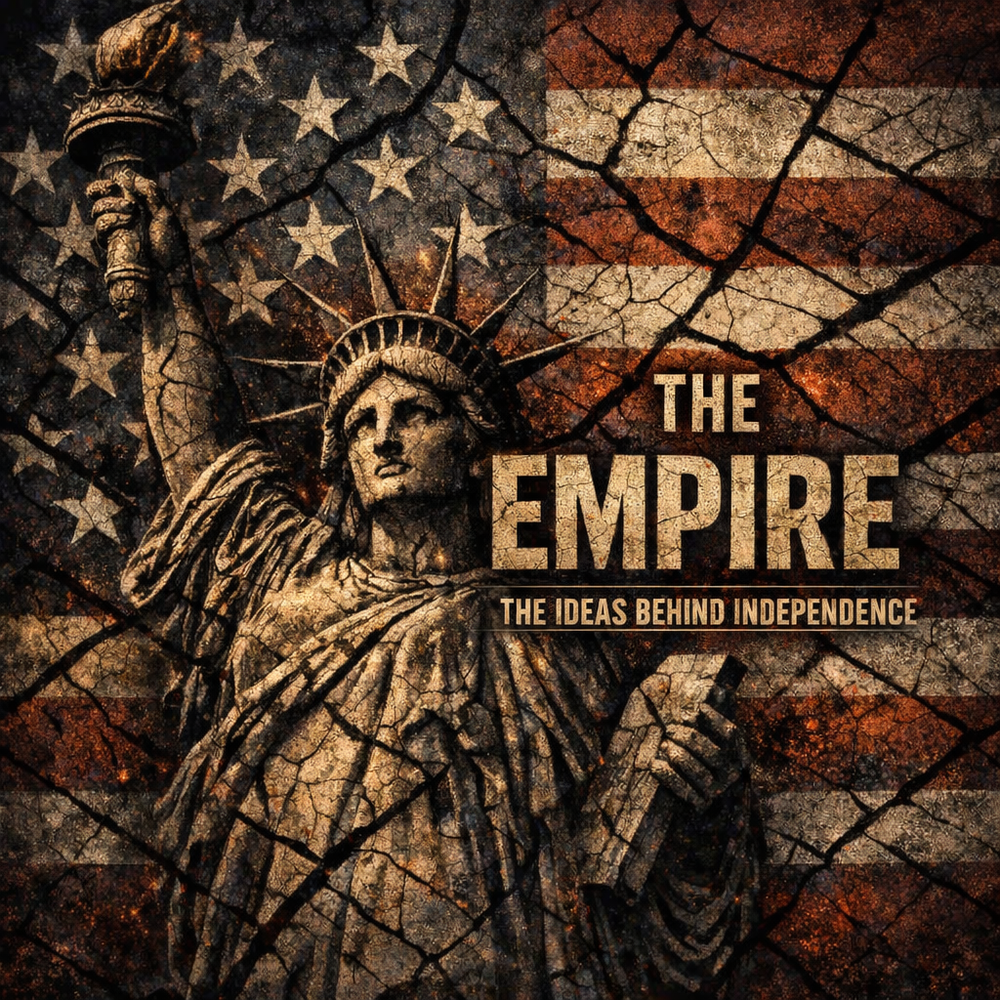
The newest episode of Empire: A 250 Year American Story steps into the threshold of the American Revolution—not through battles or declarations, but through the invisible forces that made independence possible in the first place. JB Shreve invites listeners to reconsider a familiar moment in history by asking a deceptively simple question: Why did this work at all? With no centralized communication, no unified authority, and no guarantee of legitimacy, the very idea of a new nation should have collapsed under its own contradictions. Yet in thirteen colonies—out of more than twenty in the New World—something unprecedented took root.
This episode explores the world of ideas that quietly reshaped the colonial mind long before shots were fired. From the Protestant Reformation to the Great Awakening, from the rise of literacy to the habits of local self‑government, the colonies had been incubating a culture of independence without fully realizing it. Into that environment came the Enlightenment: Locke’s natural rights, Montesquieu’s separation of powers, Rousseau’s vision of popular authority, and Voltaire’s fierce defense of conscience. These philosophies didn’t remain abstract. They filtered into sermons, pamphlets, letters, and the everyday political life of ordinary people.
JB Shreve traces how these ideas transformed grievances into a moral cause and how a population accustomed to governing itself began to see imperial control as a violation of something deeper than policy. The Committees of Correspondence, the spread of pamphlets like Common Sense, and the geographic distance from Britain all helped create a society ready—almost accidentally—to imagine a world without monarchy.
Rather than recounting events, this episode lays the intellectual groundwork for the coming crisis. It’s a story about how thoughts become movements, how movements become revolutions, and how revolutions reshape the world.





[…] The Ideas That Shaped Independence – A look at the changing perspectives and infrastructure of American worldviews that helped give rise to independence. […]
Comments are closed.