

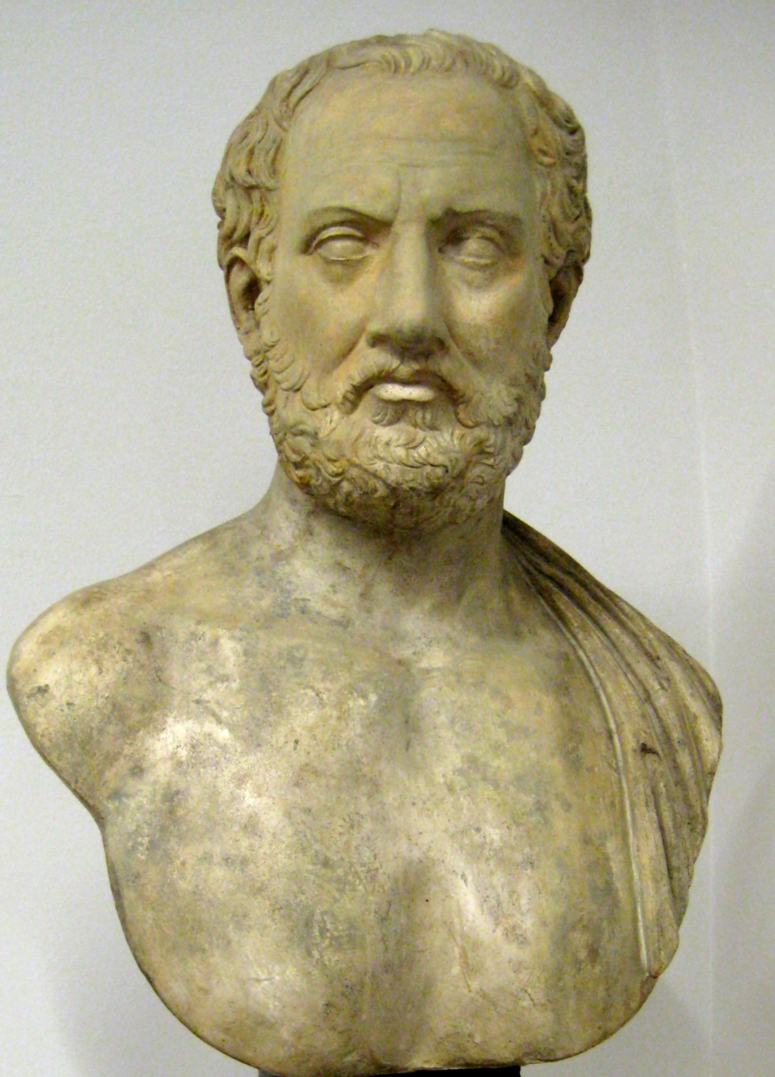
Thucydides (c. 460–c. 400 BCE) stands as one of the most influential thinkers of the ancient world—an Athenian historian, general, and analyst whose work shaped not only the study of history but the very foundations of modern international relations. Born in the Athenian deme of Halimous to a father named Olorus, who likely had Thracian aristocratic connections, Thucydides grew up in a world defined by the rise of Athenian power and the tensions that would soon erupt into the Peloponnesian War. Although little is known about his early life, later accounts suggest he may have encountered the historian Herodotus as a youth, an experience that supposedly stirred his passion for inquiry and historical writing.
Thucydides emerged into public life as a member of the Athenian elite, connected through family ties to influential figures such as Miltiades and Cimon. His wealth and status were further reinforced by his ownership of gold mines in Thrace, a resource that granted him both influence and strategic importance during the war between Athens and Sparta. When the Peloponnesian War broke out in 431 BCE, Thucydides was already old enough to grasp its significance and begin documenting its events with the meticulous eye of a soldier‑scholar.
His firsthand experience in the conflict would shape both his life and his intellectual legacy. In 424 BCE, he was elected stratēgos, a high-ranking military commander, and dispatched to defend the strategically vital city of Amphipolis. His failure to prevent its capture by the Spartan general Brasidas led to his exile from Athens for twenty years—a punishment that would ultimately become a gift to history. As Thucydides himself later wrote, exile granted him “leisure to observe affairs more closely” and the unique ability to move among both Athenian and Peloponnesian allies, gathering information from all sides of the conflict.
This dual perspective became the backbone of his monumental work, The History of the Peloponnesian War, a text that not only chronicled the conflict but revolutionized the practice of historical inquiry. Unlike Herodotus, who incorporated myth, divine causation, and cultural storytelling, Thucydides pursued what he called a “possession for all time”—a rigorous, evidence‑based account grounded in human motivations, political necessity, and the dynamics of power. For this reason, he is often called the “father of scientific history”.
Yet Thucydides’ influence extends far beyond historiography. He is widely regarded as the founding figure of political realism, the school of thought that views international politics as a struggle for power shaped by fear, self‑interest, and the pursuit of security. His analysis of the Peloponnesian War is not merely a narrative of battles but a profound exploration of how states behave under pressure, how leaders make decisions, and how power imbalances drive conflict.
One of the most famous examples of his realist insight is the Melian Dialogue, in which Athenian envoys bluntly assert that “the strong do what they can and the weak suffer what they must.” This stark articulation of power politics has become a foundational text in international relations theory, illustrating the logic of coercion, deterrence, and the tragic consequences of idealism in an anarchic world system. The dialogue remains required reading in military academies and political science programs worldwide.
Thucydides also offered a penetrating analysis of human nature, arguing that fear, honor, and interest—what later scholars would call the “Thucydidean triad”—drive both individuals and states into conflict. His account of the plague in Athens, the civil war in Corcyra, and the rise of demagogues like Cleon reveals how crises expose the darker impulses of human behavior, eroding norms and destabilizing political communities. These insights continue to inform contemporary discussions of war psychology, state collapse, and the fragility of democratic institutions.
His portrayal of Pericles, whom he admired as a model of prudent leadership, further underscores his contribution to political theory. Thucydides’ reconstruction of Pericles’ Funeral Oration remains one of the most studied speeches in Western literature, offering a vision of democratic values, civic duty, and national identity that continues to resonate today. At the same time, his critique of Athens’ later leaders highlights the dangers of populism, strategic overreach, and the erosion of disciplined statecraft.
Thucydides’ life after his exile remains obscure. Ancient sources suggest he may have returned to Athens after its defeat in 404 BCE, possibly due to a law passed by the statesman Oenobius, but the details are uncertain. His History ends abruptly in 411 BCE, leading scholars to conclude that he died before completing it, perhaps violently while traveling back to Athens.
Despite the gaps in his biography, Thucydides’ intellectual legacy is unmistakable. His work laid the groundwork for realist thinkers from Machiavelli to Hobbes to Hans Morgenthau. His insights into power transitions have shaped modern theories such as the “Thucydides Trap,” which examines the likelihood of war when a rising power threatens to displace an established one. His insistence on empirical observation, rational analysis, and the centrality of human nature continues to guide scholars, diplomats, and military strategists.
Thucydides sought to understand not only what happened in the Peloponnesian War but why it happened—and in doing so, he uncovered patterns of behavior that transcend time and culture. His work remains a mirror in which every generation can see its own struggles with power, fear, ambition, and the fragile pursuit of peace.