
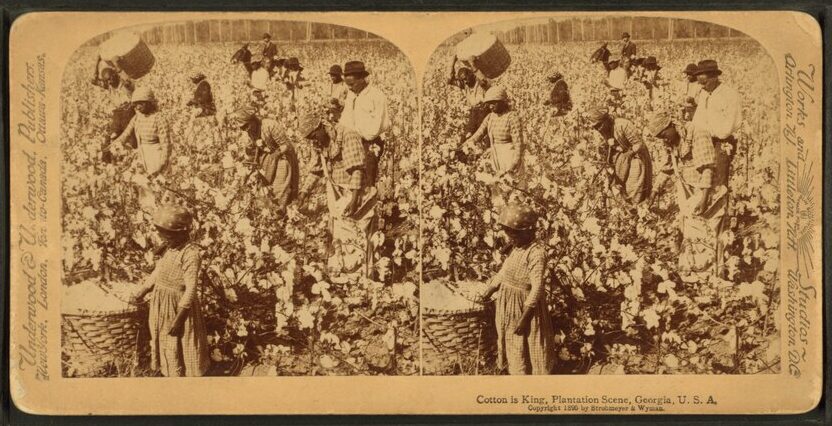
Before the Civil War, no commodity shaped the global economy more profoundly than American cotton. During the first half of the nineteenth century, cotton became the essential raw material of the Industrial Revolution, feeding the textile mills of Britain, France, and New England. Steam engines, mechanized spinning frames, and power looms transformed manufacturing, but none of these machines could operate without a steady supply of cotton. By providing that supply on an enormous scale, the American South became one of the world’s most economically important regions. In many ways, it occupied a position similar to that of the major oil-producing states of the modern Middle East: it controlled the resource that powered the world’s fastest-growing industries.
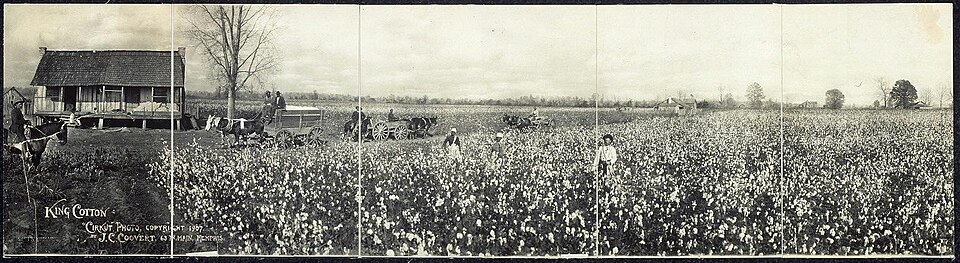
King Cotton.
The growth of American cotton production was staggering. In 1790, the United States produced only about 3,000 bales of cotton annually. The invention of Eli Whitney’s cotton gin in 1793 made it practical to clean short-staple cotton quickly and profitably, opening millions of inland acres to cultivation. By 1820, production had risen to roughly 335,000 bales. By 1840 it exceeded 2.1 million bales, and by 1860 the South harvested nearly 5 million bales each year. During the same period, American cotton exports grew from less than $1 million annually in the early 1790s to nearly $192 million in 1860, accounting for approximately 57 percent of all American export earnings. No other American product came close to matching its economic importance.
The British textile industry became especially dependent upon Southern cotton. By the late 1850s, roughly four-fifths of the cotton consumed by British mills originated in the American South. Cities such as Manchester and Liverpool flourished because ships continuously carried millions of pounds of raw cotton across the Atlantic. Thousands of factories, hundreds of thousands of workers, and countless investors depended upon uninterrupted shipments from Southern plantations. Cotton linked the economies of Europe and the United States more closely than almost any other commodity.
This immense economic influence gave rise to the phrase “King Cotton.” Although Southern politicians had used similar language earlier, the phrase became famous in 1858 when Senator James Henry Hammond of South Carolina declared before the United States Senate, “Cotton is king.” Hammond argued that because Britain and much of Europe relied so heavily upon Southern cotton, no foreign nation would dare oppose the Confederacy if the South ever left the Union. In his mind, cotton had become more powerful than armies or governments because it controlled the lifeblood of the world’s industrial economy.
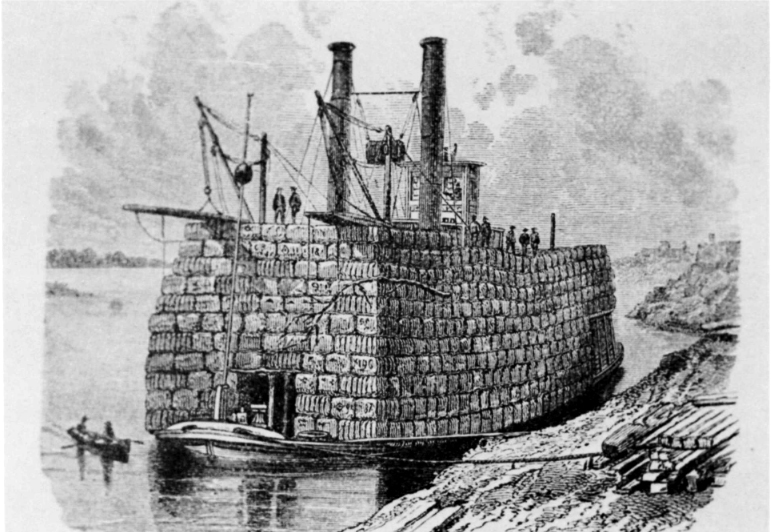
The reality behind Hammond’s boast was undeniable, even if his political conclusions proved mistaken. Cotton generated enormous wealth, encouraged westward expansion into Alabama, Mississippi, Louisiana, Arkansas, and Texas, and fueled the rapid growth of slavery. Between 1790 and 1860, the enslaved population of the United States expanded from approximately 700,000 people to nearly 4 million, largely because plantation owners demanded more labor to produce ever-increasing quantities of cotton. The prosperity of Southern planters became inseparable from the institution of slavery.
By 1860, “King Cotton” had become more than a slogan—it was the foundation of the Southern economy and one of the principal causes of sectional conflict. As Northern states increasingly industrialized and many came to oppose the expansion of slavery, Southern leaders viewed any threat to cotton production as an existential threat to their wealth and political power. Much as oil has shaped the politics, diplomacy, and conflicts of the modern Middle East, cotton shaped the politics of antebellum America. It enriched a region, transformed the global economy, and ultimately helped drive the nation toward the Civil War.