

When the United States dropped the atomic bomb on Hiroshima on August 6, 1945, humanity crossed a threshold from which there would be no return. In a single instant, one weapon unleashed destructive power equivalent to approximately 15,000 tons of TNT, devastating a city and ultimately contributing to the deaths of an estimated 140,000 people by the end of the year. Three days later, a second atomic bomb destroyed much of Nagasaki (pictured above).
Yet, as unimaginable as these weapons were, the bombs dropped on Japan were primitive compared to the nuclear weapons developed in the decades that followed. Within twenty years, scientists had created bombs thousands of times more powerful, while engineers developed missiles capable of delivering them to virtually any location on Earth.
The nuclear age had only begun.
The First Generation: Splitting the Atom
The scientific foundations of nuclear weapons emerged in 1938, when German chemists Otto Hahn and Fritz Strassmann discovered evidence of nuclear fission. Physicists Lise Meitner and Otto Frisch subsequently explained the process: splitting the nucleus of a heavy atom could release enormous amounts of energy.
The Manhattan Project transformed this discovery into a weapon.

The Hiroshima bomb, nicknamed Little Boy, used uranium-235 and a relatively simple mechanism that brought two subcritical masses together to produce an explosive chain reaction. The Nagasaki bomb, Fat Man, employed plutonium-239 and a more sophisticated implosion mechanism.
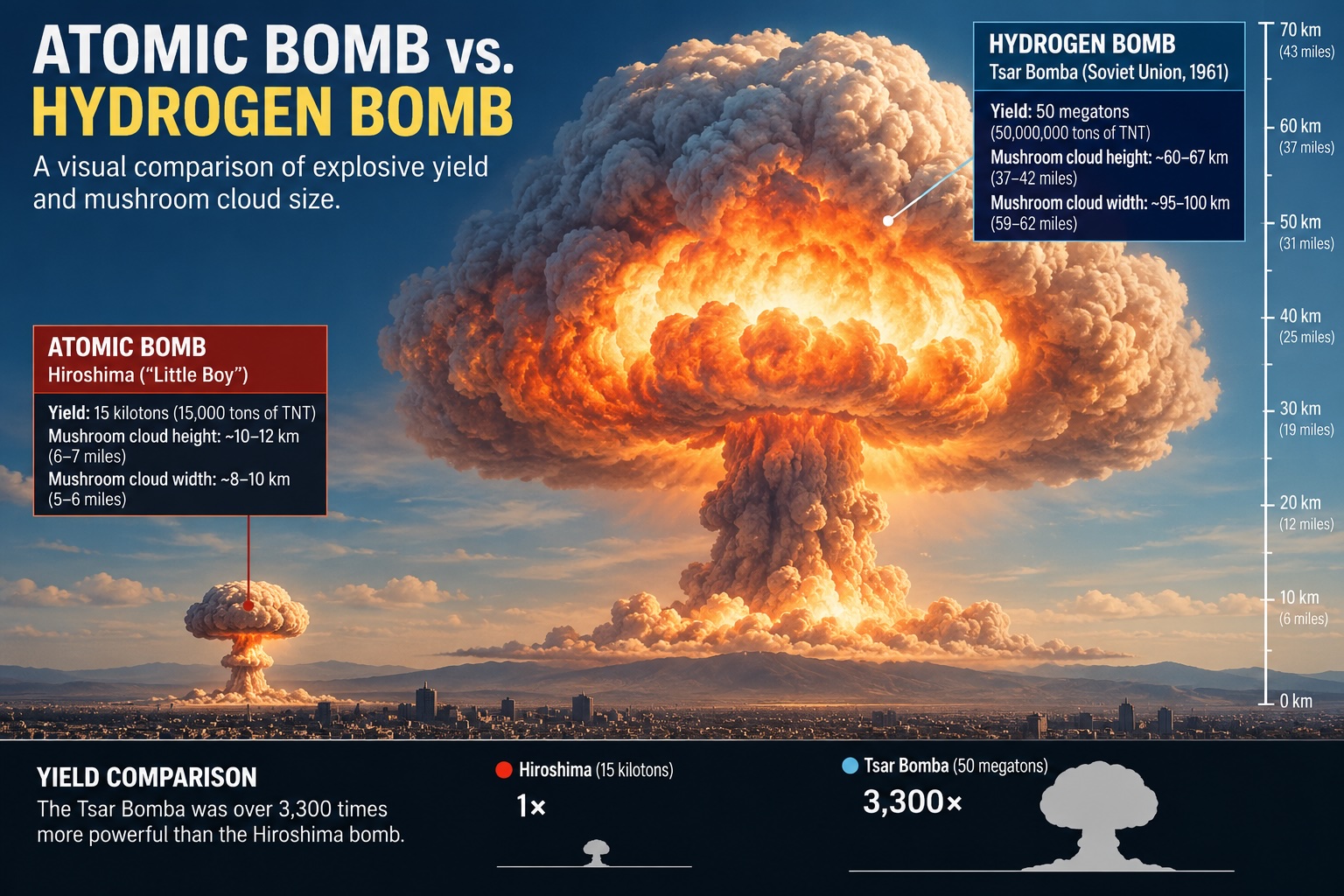
Little Boy produced approximately 15 kilotons of explosive energy, while Fat Man generated roughly 21 kilotons.
For perspective, a single kiloton represents the explosive force of 1,000 tons of TNT. These two bombs released more destructive energy in seconds than conventional bombing raids involving hundreds of aircraft.
But the next generation would make these weapons seem almost insignificant by comparison.
The Hydrogen Bomb: A Thousandfold Leap
During the early 1950s, American scientists developed an entirely new category of nuclear weapon: the hydrogen bomb.
Unlike the original atomic bombs, which relied on nuclear fission, hydrogen bombs incorporated nuclear fusion—the process that powers the sun.
In a thermonuclear weapon, an initial fission explosion creates the extraordinary temperatures and pressures necessary to trigger fusion reactions in a secondary stage. Some designs also generate substantial additional energy through fission.
The resulting increase in destructive power was staggering.
In November 1952, the United States detonated Ivy Mike, the world’s first full-scale thermonuclear test. It produced an explosion equivalent to 10.4 million tons of TNT—approximately 700 times the power of Hiroshima.

The explosion vaporized the Pacific island on which the device had been constructed, leaving an enormous crater.
Two years later, the United States tested Castle Bravo, producing a 15-megaton explosion—roughly 1,000 times Hiroshima’s yield. Unexpectedly high radioactive fallout contaminated surrounding islands and exposed nearby populations and a Japanese fishing crew to dangerous radiation.
The Soviet Union pushed the technology even further.
On October 30, 1961, the Soviets detonated Tsar Bomba, the largest nuclear weapon ever tested.
Its explosive yield reached approximately 50 megatons, more than 3,300 times the power of the Hiroshima bomb.
The fireball stretched several miles across. Its mushroom cloud climbed approximately 40 miles into the atmosphere. The shock wave traveled around the Earth, and windows reportedly shattered hundreds of miles from the explosion.
The original design had contemplated a yield of approximately 100 megatons, but Soviet scientists reduced it partly to limit radioactive fallout.
Humanity had developed the ability to destroy entire metropolitan regions with a single weapon.

Miniaturization: Making Nuclear Weapons Smaller and More Dangerous
By the late 1950s, nuclear weapons development moved in another direction.
Rather than simply constructing larger bombs, scientists learned to produce powerful nuclear explosions from increasingly compact devices.
This transformation proved enormously consequential.
Early nuclear weapons required large aircraft to transport them. Newer designs could fit inside artillery shells, missiles, torpedoes, and other military systems.
The United States even developed the Davy Crockett, a small battlefield nuclear weapon system introduced during the early 1960s. Its nuclear projectile produced an explosion equivalent to approximately 20 tons of TNT, dramatically smaller than Hiroshima but still extraordinarily destructive for its size.
Military planners envisioned using tactical nuclear weapons against enemy troop formations, armored divisions, airfields, and military installations.
This development introduced a disturbing possibility: nuclear weapons might become ordinary instruments of battlefield warfare rather than weapons reserved for national emergencies.
The distinction between conventional warfare and nuclear annihilation was becoming dangerously blurred.
The Missile Revolution: Delivering Destruction Anywhere
Meanwhile, nuclear weapons were undergoing another transformation that would fundamentally reshape international politics.
During World War II, Germany had pioneered long-range ballistic missile technology with its V-2 rockets. Following the war, American and Soviet scientists expanded this technology into increasingly powerful missile systems.
By the late 1950s, both superpowers were developing intercontinental ballistic missiles, or ICBMs, capable of carrying nuclear warheads thousands of miles.
A weapon that once required a bomber to penetrate enemy airspace could now reach another continent in approximately thirty minutes.
Submarine-launched ballistic missiles made the threat even more formidable. Nuclear-armed submarines could remain concealed beneath the oceans, capable of launching devastating retaliatory strikes even after their homeland suffered a surprise attack.
By the 1970s, another breakthrough multiplied the danger.
Multiple Independently Targetable Reentry Vehicles, or MIRVs, allowed a single missile to carry several nuclear warheads, each directed toward a different target.
One missile could now threaten multiple cities or military installations simultaneously.
At the same time, advances in guidance technology dramatically improved accuracy, allowing smaller warheads to destroy hardened military targets that previously required much larger explosions.
The danger was no longer measured simply by the explosive power of individual bombs, but by the speed, accuracy, number, and survivability of the weapons available.
The Nuclear Arsenal and the Threat of Civilization’s Destruction
By the mid-1980s, the global nuclear stockpile had reached approximately 70,000 warheads, overwhelmingly controlled by the United States and Soviet Union.
Many were considerably more powerful than the bombs dropped on Japan.
The destructive potential was almost beyond comprehension. A large-scale nuclear exchange could kill tens or hundreds of millions of people directly, devastate infrastructure, contaminate enormous territories, and potentially trigger severe global climatic disruptions that would threaten agricultural production.
Fortunately, nuclear stockpiles declined substantially following the Cold War. Nevertheless, thousands of nuclear warheads remain in military inventories today, and several nuclear-armed nations continue modernizing their arsenals.
The evolution of nuclear technology reveals a remarkable contradiction in human progress.
In less than two decades after Hiroshima, humanity advanced from a single atomic explosion equivalent to 15,000 tons of TNT to a thermonuclear explosion exceeding 50 million tons.
Scientific achievement had delivered unprecedented technological power without providing any corresponding guarantee of human wisdom.
The fundamental question confronting humanity was no longer whether civilization possessed the technology to destroy itself.
It was whether civilization possessed the wisdom to prevent that technology from ever being used.