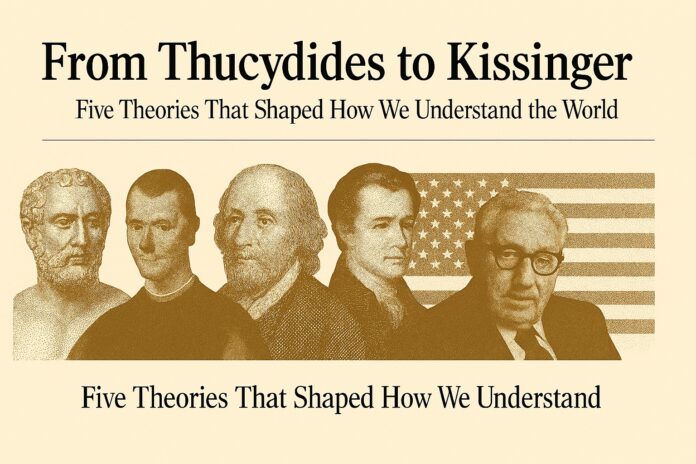
Reading Time: 5 minutesInternational relations has always been, at its core, an attempt to make sense of why nations compete, cooperate, and sometimes collide. Long before the field had a name, thinkers were trying to decode the logic of power—why states rise, why they fall, and why peace so often slips through human fingers. From the battlefields of ancient Greece to the diplomatic chessboards of the Cold War, five major perspectives have defined this long intellectual arc.
1. Classical Realism — Thucydides and the Tragic Logic of Power
The story begins with Thucydides, the exiled Athenian general whose *History of the Peloponnesian War* is widely considered the first great text of international relations. His account of the conflict between Athens and Sparta is not just a chronicle of battles; it is a study of fear, ambition, and the unforgiving nature of an anarchic world. Scholars note that Thucydides provided “the foundations of what has been called in modern times Realpolitik or political realism”.
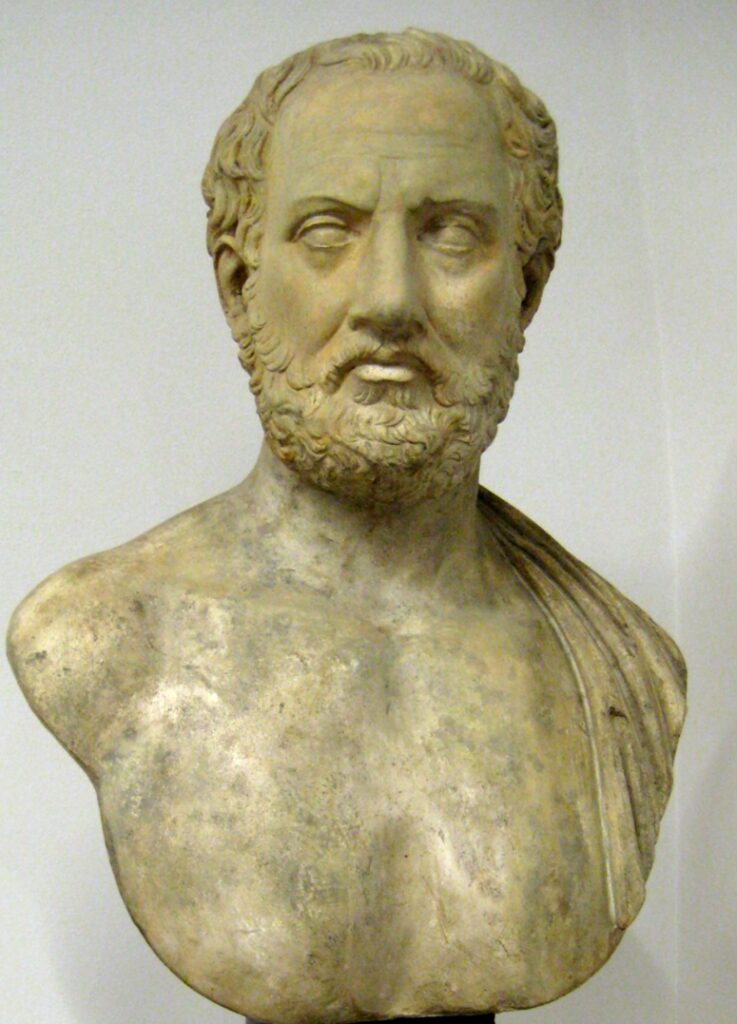
In the famous Melian Dialogue, the Athenians declare that “the strong do what they can and the weak suffer what they must”—a line that has echoed through centuries of strategic thought. For Thucydides, the international arena is defined by the absence of a higher authority, the primacy of self‑interest, and the tragic inevitability of conflict when rising and established powers collide. Modern realists—from Hans Morgenthau to Henry Kissinger—still draw on his insights.
2. Renaissance Realism — Machiavelli and the Effectual Truth of Politics
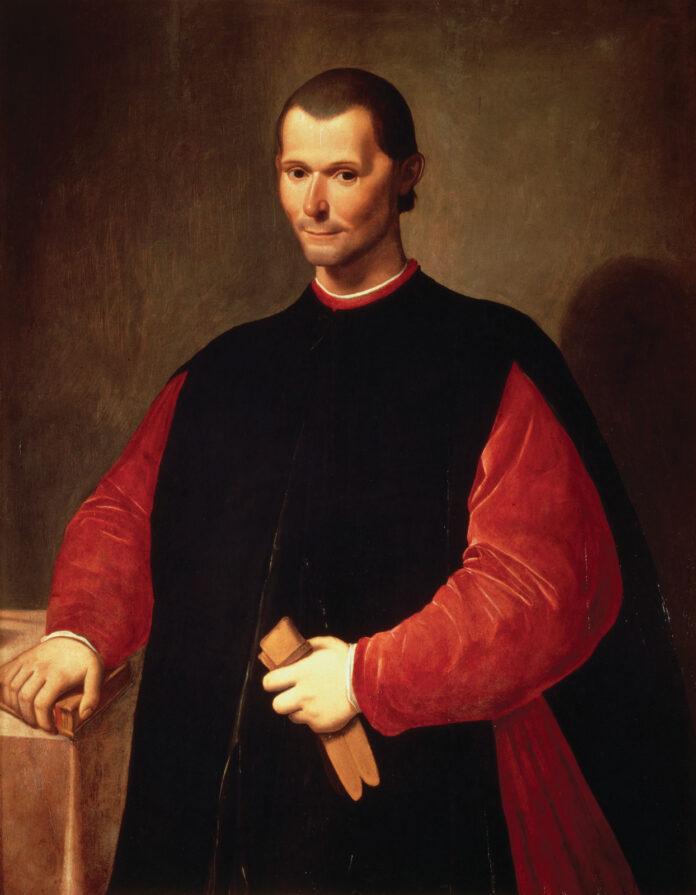
Nearly two millennia later, Niccolò Machiavelli sharpened realism into something colder and more clinical. Writing in the fractious world of Renaissance Italy, he observed firsthand how states maneuvered for advantage amid shifting alliances and foreign invasions. His work helped shape what scholars call “Classical Realism,” a tradition that includes Thucydides, Hobbes, and later Kissinger.
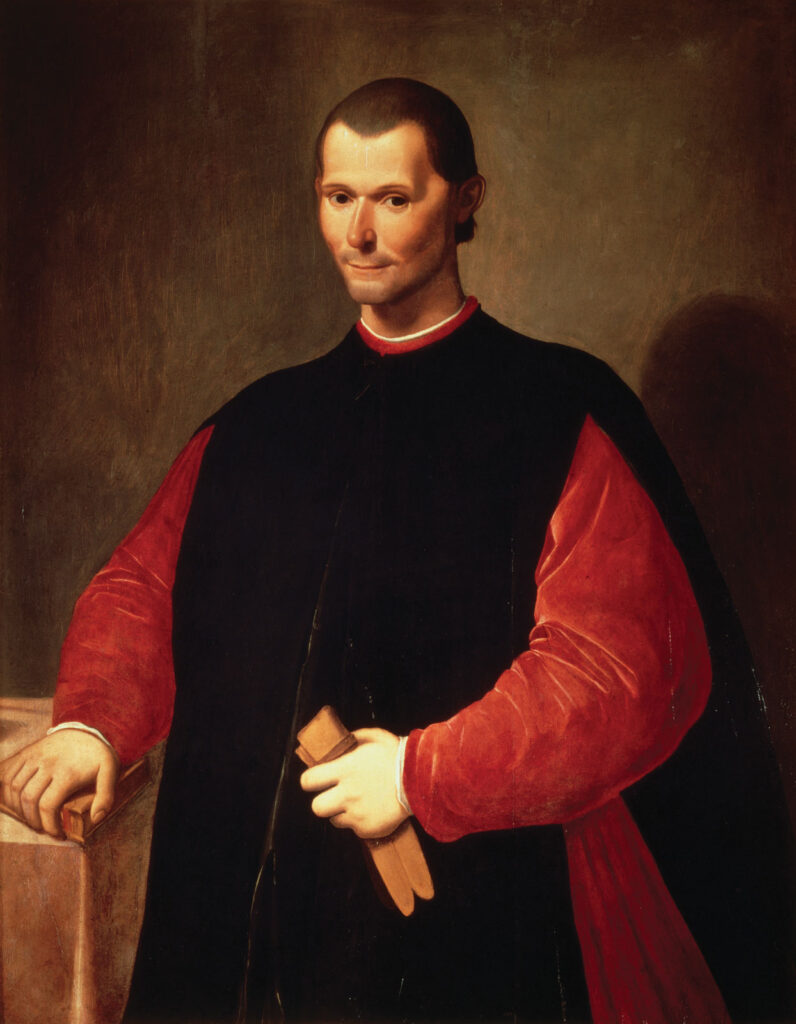
Machiavelli’s contribution was to strip politics of moral pretenses. In The Prince and The Discourses, he argued that rulers must understand the world as it is, not as they wish it to be. Power, he insisted, rests on military strength, strategic deception, and the ability to adapt to fortune’s turns. His realism was not cynicism for its own sake; it was a call to confront the “effectual truth” of political life. In international relations, this meant recognizing that states act out of necessity, not virtue.
3. Liberal Internationalism — The Hope for Cooperation After Catastrophe
If realism is the study of limits, liberalism is the study of possibilities. After World War I, as scholars sought alternatives to the balance‑of‑power politics that had failed so catastrophically, a new perspective emerged: liberal internationalism. It argued that war was not inevitable and that institutions, law, and economic interdependence could tame the anarchic system.
The discipline of international relations itself is often traced to this moment, with the establishment of the first academic chair in the field after the war. Liberal theorists believed that collective security—embodied in the League of Nations—could replace the old logic of rivalry. Though the League faltered, the liberal vision endured, later shaping the United Nations, NATO, and the post‑1945 economic order.
Liberalism’s core claim is that states are not doomed to perpetual conflict. Cooperation is possible when institutions reduce uncertainty, when democracies restrain aggression, and when trade binds nations together. It is a hopeful counterpoint to realism’s darker assumptions.
4. Neorealism and Neoliberalism — The Cold War’s Structural Turn
By the mid‑20th century, realism and liberalism were both reimagined through a more scientific lens. The Cold War’s stark bipolarity encouraged scholars to think in terms of systems, structures, and predictable patterns.
Kenneth Waltz’s Theory of International Politics (1979) pioneered neorealism, arguing that the structure of the international system—not human nature—drives state behavior. In an anarchic world, states must rely on self‑help, balance against threats, and prioritize survival. Power is measured not only in armies but in the distribution of capabilities across the system.
Neoliberalism (or liberal institutionalism) emerged as neorealism’s intellectual rival. Scholars like Robert Keohane and Joseph Nye argued that even in an anarchic world, institutions matter. They reduce transaction costs, create expectations, and allow cooperation to flourish even among self‑interested states. Neoliberalism did not reject realism; it refined it, suggesting that states can pursue absolute gains—not just relative ones—when institutions stabilize expectations.
Together, neorealism and neoliberalism defined the theoretical battleground of late‑20th‑century IR.
5. Constructivism and the Power of Ideas — A New Lens for a New Era
As the Cold War ended, something unexpected happened: the system changed without a shot fired. The Soviet Union collapsed, Germany reunified, and long‑standing alliances reshaped themselves. Material power alone could not explain these transformations.
Enter constructivism, the third major framework of modern IR. Emerging in the late 1980s and 1990s, constructivism argued that international politics is shaped not only by material forces but by ideas, identities, and social norms. Scholars such as Alexander Wendt and Martha Finnemore helped pioneer this approach.
Constructivism’s core insight is simple but profound: states act based on who they believe they are and what they believe others are. Anarchy, Wendt famously wrote, “is what states make of it.” The U.S. does not fear British nuclear weapons the way it fears North Korean ones—not because of capabilities, but because of identities and relationships.
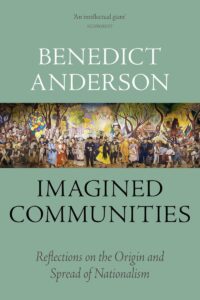
Constructivism opened the door to studying nationalism, human rights, culture, and ideology as drivers of global politics. It explained why norms like sovereignty, humanitarian intervention, and nuclear restraint evolve over time.
The Kissinger Synthesis — Realism for the Modern Age
Henry Kissinger, the diplomat‑scholar who helped steer U.S. foreign policy during the Cold War, stands as a bridge between classical realism and contemporary strategic thought. His work draws heavily on Thucydides and the realist tradition, but he also understood the importance of diplomacy, perception, and psychological nuance.
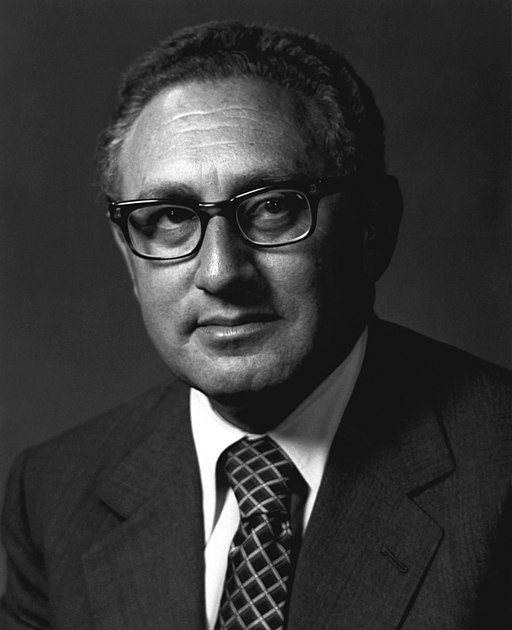
Kissinger’s statecraft emphasized balance of power, spheres of influence, and the need for order in a world prone to chaos. Yet he also recognized that legitimacy—shared understandings of acceptable behavior—is essential for stability. In this sense, his perspective blends realist and constructivist insights, making him one of the most influential strategic thinkers of the modern era.
A Living Conversation
From Thucydides’ stark realism to Kissinger’s strategic pragmatism, from liberal hopes for cooperation to constructivist attention to identity, the study of international relations has evolved alongside the world it seeks to explain. These perspectives do not replace one another; they coexist, offering different lenses for different moments.
In a century defined by rising powers, technological upheaval, and renewed geopolitical rivalry, the old questions remain. Why do states fight? How do they cooperate? And what, if anything, can prevent history from repeating itself?
The answers, as always, depend on which lens we choose to look through.
If you are interested in learning more about this topic, you will enjoy our podcast series, How the World Works, where we explore the field of International Relations.