
Home Blog Page 3

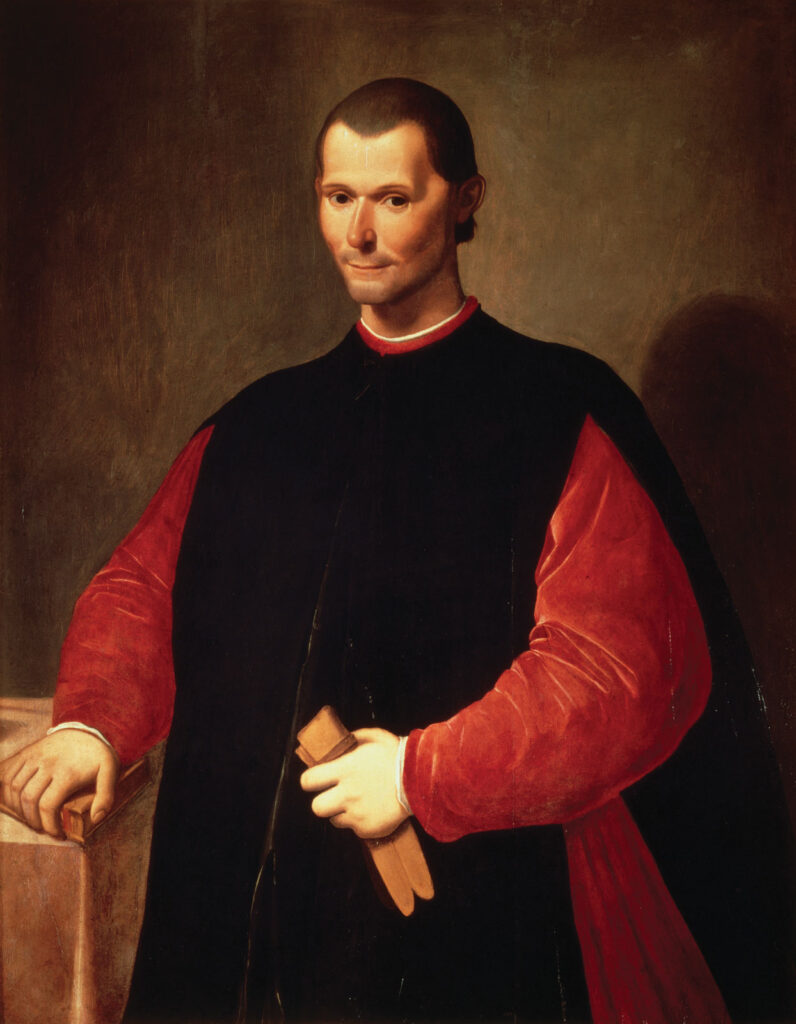
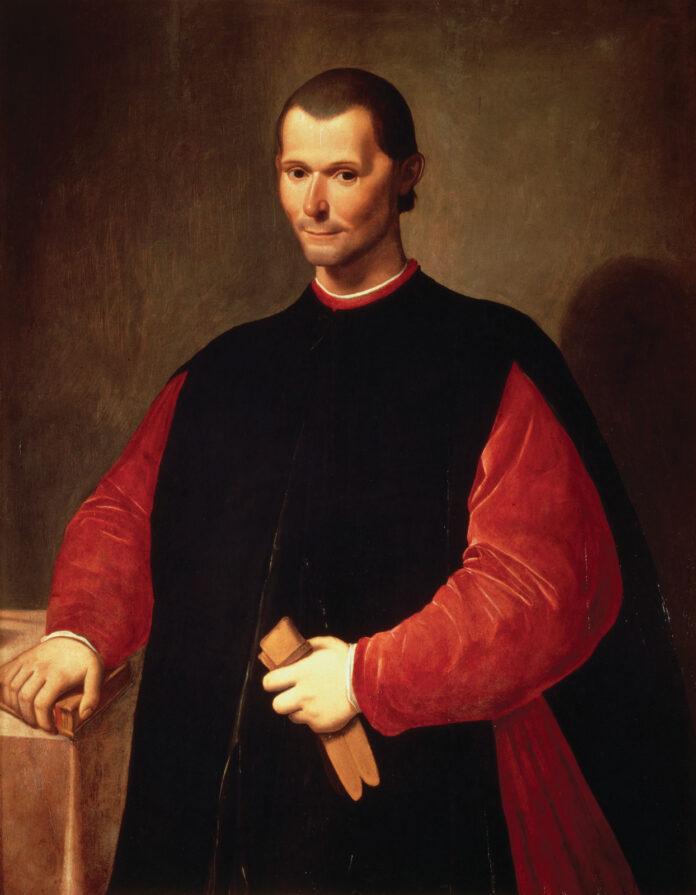
Who Was Machiavelli?

0
Reading Time: 4 minutes

Niccolò Machiavelli (1469–1527) remains one of the most provocative and influential political thinkers in Western history—a Florentine diplomat, historian, philosopher, and civil servant whose writings helped lay the foundations for modern political science and, crucially, the realist tradition in international relations. Born on May 3, 1469, in Florence, Machiavelli grew up during the Italian Renaissance, a period marked by artistic flourishing, intellectual revival, and intense political fragmentation. Italy at the time was not a unified nation but a patchwork of competing city‑states—Florence, Venice, Milan, Naples, and the Papal States—each vying for influence while foreign powers like France and Spain intervened aggressively in Italian affairs. This volatile environment shaped Machiavelli’s worldview and provided the raw material for his later political theories.

Machiavelli entered public service in 1498, shortly after the fall of the fiery preacher Girolamo Savonarola. He was appointed secretary to the Second Chancery of the Florentine Republic, a position that placed him at the heart of diplomatic and military affairs. For fourteen years, he traveled across Europe as a diplomat, meeting rulers, observing courts, and negotiating on behalf of Florence. These experiences exposed him to the brutal realities of power politics—alliances made and broken, states rising and falling, and leaders who succeeded not through virtue in the moral sense but through strategic calculation, deception, and force.

His diplomatic missions brought him into contact with some of the most formidable political actors of his time, including Cesare Borgia, whose ruthless efficiency and political cunning left a deep impression on Machiavelli. These encounters convinced him that political success depended not on idealistic moral principles but on a clear‑eyed understanding of human nature, necessity, and power.

In 1512, the Medici family returned to power in Florence, overthrowing the republic Machiavelli had served. He was dismissed, imprisoned, and tortured on suspicion of conspiracy. After his release, he retreated to his family estate at Sant’Andrea in Percussina. It was during this enforced political exile that he wrote his most famous work, The Prince, completed around 1513 but published posthumously in 1532. Although often interpreted as a manual for tyrants, The Prince is better understood as a study of political survival in a world governed by uncertainty, ambition, and conflict.

Machiavelli’s contributions to international relations emerge most clearly from this realist orientation. He rejected the utopianism of earlier political thinkers and instead grounded his analysis in what he called “the effectual truth” of politics—how states actually behave rather than how they ought to behave. Scholars note that “the whole drift of his work is toward a political realism, unknown to the formal writing of his time”. In this sense, Machiavelli stands alongside Thucydides and later Hobbes as a foundational figure in the realist tradition.

Several key themes in Machiavelli’s writings have become central to international relations theory:

1. The Primacy of Power and Security

Machiavelli argued that the survival of the state is the highest political good. Everything else—morality, tradition, even justice—must be subordinated to the preservation of political order. This emphasis on security as the core interest of states is a defining feature of realism and remains central to IR scholarship today.

2. Human Nature as a Driver of Political Behavior

Machiavelli’s view of human nature was famously pessimistic. He believed people are driven by fear, ambition, and self‑interest—traits that shape not only domestic politics but also the behavior of states on the international stage. As one scholar notes, Machiavelli saw fear as “the greatest master” in foreign policy.

3. The Interdependence of Domestic and International Politics

Long before modern IR theorists articulated the “two‑level game,” Machiavelli recognized that domestic stability is a prerequisite for effective foreign policy. A state torn by internal conflict cannot project power abroad. Conversely, foreign threats can reshape domestic institutions. This insight appears throughout The Discourses and his diplomatic correspondence.

4. The Role of Military Power

Machiavelli insisted that “good laws and good arms” are the twin foundations of a strong state. He distrusted mercenaries and auxiliaries, arguing that a state must rely on its own military forces to ensure independence. This emphasis on self‑help echoes the core realist assumption that states must provide for their own security in an anarchic international system.

5. The Instability of Alliances and International Arrangements

Machiavelli observed that alliances are fragile, shaped by shifting interests rather than loyalty or shared values. He warned that neutrality is often dangerous and that states must be prepared to adapt quickly to changing circumstances. These ideas anticipate modern theories of balance of power and alliance politics.

Beyond The Prince, Machiavelli’s Discourses on Livy, The Art of War, and History of Florence contain extensive reflections on foreign policy, diplomacy, and interstate conflict. His letters and dispatches reveal a keen analytical mind grappling with the complexities of international politics in a multipolar world.

Machiavelli died on June 21, 1527, in Florence, just weeks after the city fell to imperial forces. Although his name later became synonymous with political deceit, his true legacy is far more nuanced. He sought not to corrupt politics but to understand it—to strip away illusions and reveal the forces that shape human affairs.

Today, Machiavelli is widely regarded as one of the forefathers of modern realism in international relations. His insights into power, fear, ambition, and the interplay between domestic and foreign politics continue to inform the study of global affairs. In a world still marked by rivalry, uncertainty, and the struggle for security, Machiavelli’s work remains as relevant as ever.

If you are interested in learning more about this topic, you will enjoy our podcast series, How the World Works, where we explore the field of International Relations. 

The Pursuit of Power

0
pursuit of power
Reading Time: < 1 minute

Understanding the role of power in international relations is essential to grasp how the global system operates. This episode explores how power—not money, ideology, or morality—is the true engine behind international behavior. From wars and treaties to trade agreements and global institutions, power is the currency that drives state actions.

Listen to the session and take the quiz here

Historically, thinkers like Machiavelli and Hobbes emphasized that power is not just strategic but existential. Hobbes, witnessing civil war, argued that without a strong authority, society descends into chaos. This idea laid the groundwork for realism in international relations, where survival and dominance outweigh virtue.

After World War II, the United States emerged as the global Leviathan, shaping a liberal international order through military strength, economic dominance, and cultural influence. Institutions like the IMF and UN, while appearing multilateral, were structured to preserve U.S. power. This illustrates the role of power in international relations as both overt and subtle.

Joseph Nye’s concept of “soft power” adds nuance, showing that influence can also come through attraction—via culture, values, and diplomacy. In today’s multipolar world, nations must blend hard and soft power into “smart power” to navigate complex global dynamics.

This episode also contrasts worldly power with the Kingdom of God, where trust in divine authority replaces the human thirst for control. The biblical narrative of the Fall reveals how the desire to “be like God” birthed humanity’s obsession with power.

Ultimately, the role of power in international relations reflects both the structure of the global system and the condition of the human heart. Recognizing this helps us interpret global events more clearly—and invites us to imagine a different kind of kingdom.

A Biblical Model

0
biblical model of international relations
Reading Time: 2 minutes

In this thought-provoking episode, we move beyond traditional theories of international relations—Realism, Idealism, and Constructivism—and explore a radically different framework: the Kingdom of God. While secular models focus on power, cooperation, or evolving norms, this episode challenges listeners to consider how scripture reframes global affairs through the lens of human nature, divine purpose, and spiritual transformation.

We begin by revisiting the optimism of the 1990s, when thinkers like Francis Fukuyama declared “The End of History,” and liberal democracy seemed destined to triumph. But history, as always, had other plans. From Iraq to Afghanistan, the collapse of idealist visions revealed a deeper pattern—one echoed in scripture and repeated throughout the history of human civilization.

Drawing from Genesis 11, we unpack the story of the Tower of Babel as a foundational moment in biblical international relations. Humanity’s attempt to unify and build security through ambition and pride mirrors countless historical cycles. God’s intervention at Babel wasn’t about fear—it was about mercy, preventing self-destruction.

The episode then pivots to Abraham, whose calling marks the beginning of a divine model for nations. Unlike worldly systems, the Kingdom of God begins with a transformed heart, not external power. Through Abraham’s obedience, God introduces a nation built on faith, blessing, and spiritual renewal.

If you’ve ever felt the tension between your faith and the harsh realities of global politics, this episode offers clarity, hope, and a fresh perspective. Join us as we explore how the biblical narrative speaks directly to the heart of international relations—and why the Kingdom of God offers a model unlike any other.

Listen now and discover how scripture reframes the way we understand nations, power, and peace.

Listen to the full episode and take the quiz here 

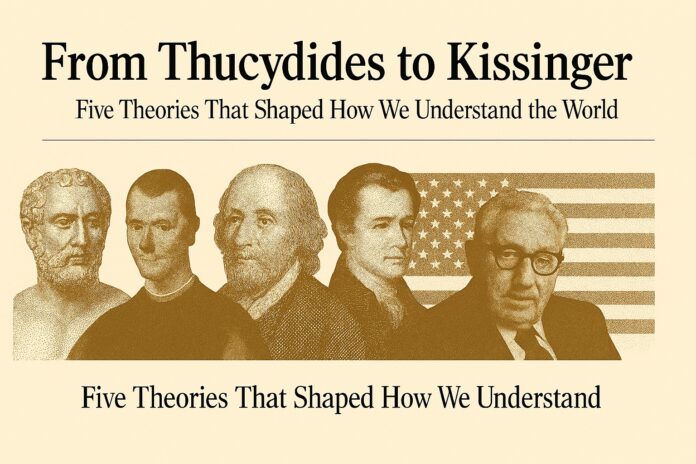
From Thucydides to Kissinger: Five Theories That Shaped How We Understand the World

0
Reading Time: 5 minutes

International relations has always been, at its core, an attempt to make sense of why nations compete, cooperate, and sometimes collide. Long before the field had a name, thinkers were trying to decode the logic of power—why states rise, why they fall, and why peace so often slips through human fingers. From the battlefields of ancient Greece to the diplomatic chessboards of the Cold War, five major perspectives have defined this long intellectual arc.

1. Classical Realism — Thucydides and the Tragic Logic of Power

The story begins with Thucydides, the exiled Athenian general whose *History of the Peloponnesian War* is widely considered the first great text of international relations. His account of the conflict between Athens and Sparta is not just a chronicle of battles; it is a study of fear, ambition, and the unforgiving nature of an anarchic world. Scholars note that Thucydides provided “the foundations of what has been called in modern times Realpolitik or political realism”.

In the famous Melian Dialogue, the Athenians declare that “the strong do what they can and the weak suffer what they must”—a line that has echoed through centuries of strategic thought. For Thucydides, the international arena is defined by the absence of a higher authority, the primacy of self‑interest, and the tragic inevitability of conflict when rising and established powers collide. Modern realists—from Hans Morgenthau to Henry Kissinger—still draw on his insights.

2. Renaissance Realism — Machiavelli and the Effectual Truth of Politics

Nearly two millennia later, Niccolò Machiavelli sharpened realism into something colder and more clinical. Writing in the fractious world of Renaissance Italy, he observed firsthand how states maneuvered for advantage amid shifting alliances and foreign invasions. His work helped shape what scholars call “Classical Realism,” a tradition that includes Thucydides, Hobbes, and later Kissinger.

Machiavelli’s contribution was to strip politics of moral pretenses. In The Prince and The Discourses, he argued that rulers must understand the world as it is, not as they wish it to be. Power, he insisted, rests on military strength, strategic deception, and the ability to adapt to fortune’s turns. His realism was not cynicism for its own sake; it was a call to confront the “effectual truth” of political life. In international relations, this meant recognizing that states act out of necessity, not virtue.

3. Liberal Internationalism — The Hope for Cooperation After Catastrophe

If realism is the study of limits, liberalism is the study of possibilities. After World War I, as scholars sought alternatives to the balance‑of‑power politics that had failed so catastrophically, a new perspective emerged: liberal internationalism. It argued that war was not inevitable and that institutions, law, and economic interdependence could tame the anarchic system.

The discipline of international relations itself is often traced to this moment, with the establishment of the first academic chair in the field after the war. Liberal theorists believed that collective security—embodied in the League of Nations—could replace the old logic of rivalry. Though the League faltered, the liberal vision endured, later shaping the United Nations, NATO, and the post‑1945 economic order.

Liberalism’s core claim is that states are not doomed to perpetual conflict. Cooperation is possible when institutions reduce uncertainty, when democracies restrain aggression, and when trade binds nations together. It is a hopeful counterpoint to realism’s darker assumptions.

4. Neorealism and Neoliberalism — The Cold War’s Structural Turn

By the mid‑20th century, realism and liberalism were both reimagined through a more scientific lens. The Cold War’s stark bipolarity encouraged scholars to think in terms of systems, structures, and predictable patterns.

Kenneth Waltz’s Theory of International Politics (1979) pioneered neorealism, arguing that the structure of the international system—not human nature—drives state behavior. In an anarchic world, states must rely on self‑help, balance against threats, and prioritize survival. Power is measured not only in armies but in the distribution of capabilities across the system.

Neoliberalism (or liberal institutionalism) emerged as neorealism’s intellectual rival. Scholars like Robert Keohane and Joseph Nye argued that even in an anarchic world, institutions matter. They reduce transaction costs, create expectations, and allow cooperation to flourish even among self‑interested states. Neoliberalism did not reject realism; it refined it, suggesting that states can pursue absolute gains—not just relative ones—when institutions stabilize expectations.

Together, neorealism and neoliberalism defined the theoretical battleground of late‑20th‑century IR.

5. Constructivism and the Power of Ideas — A New Lens for a New Era

As the Cold War ended, something unexpected happened: the system changed without a shot fired. The Soviet Union collapsed, Germany reunified, and long‑standing alliances reshaped themselves. Material power alone could not explain these transformations.

Enter constructivism, the third major framework of modern IR. Emerging in the late 1980s and 1990s, constructivism argued that international politics is shaped not only by material forces but by ideas, identities, and social norms. Scholars such as Alexander Wendt and Martha Finnemore helped pioneer this approach.

Constructivism’s core insight is simple but profound: states act based on who they believe they are and what they believe others are. Anarchy, Wendt famously wrote, “is what states make of it.” The U.S. does not fear British nuclear weapons the way it fears North Korean ones—not because of capabilities, but because of identities and relationships.

Constructivism opened the door to studying nationalism, human rights, culture, and ideology as drivers of global politics. It explained why norms like sovereignty, humanitarian intervention, and nuclear restraint evolve over time.

The Kissinger Synthesis — Realism for the Modern Age

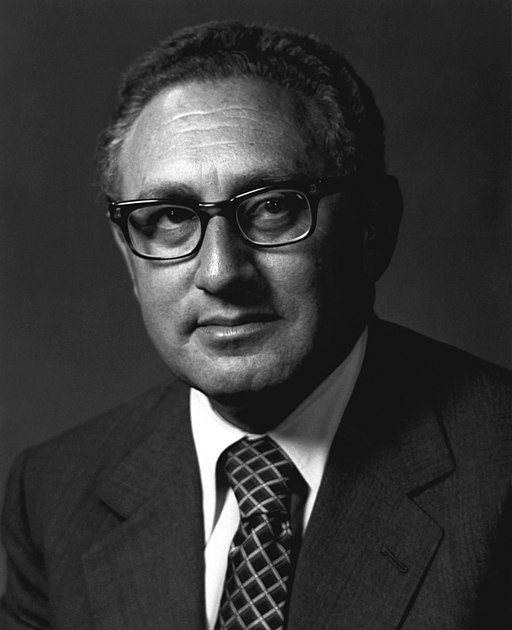
Henry Kissinger, the diplomat‑scholar who helped steer U.S. foreign policy during the Cold War, stands as a bridge between classical realism and contemporary strategic thought. His work draws heavily on Thucydides and the realist tradition, but he also understood the importance of diplomacy, perception, and psychological nuance.

Kissinger’s statecraft emphasized balance of power, spheres of influence, and the need for order in a world prone to chaos. Yet he also recognized that legitimacy—shared understandings of acceptable behavior—is essential for stability. In this sense, his perspective blends realist and constructivist insights, making him one of the most influential strategic thinkers of the modern era.

A Living Conversation

From Thucydides’ stark realism to Kissinger’s strategic pragmatism, from liberal hopes for cooperation to constructivist attention to identity, the study of international relations has evolved alongside the world it seeks to explain. These perspectives do not replace one another; they coexist, offering different lenses for different moments.

In a century defined by rising powers, technological upheaval, and renewed geopolitical rivalry, the old questions remain. Why do states fight? How do they cooperate? And what, if anything, can prevent history from repeating itself?

The answers, as always, depend on which lens we choose to look through.


If you are interested in learning more about this topic, you will enjoy our podcast series, How the World Works, where we explore the field of International Relations.

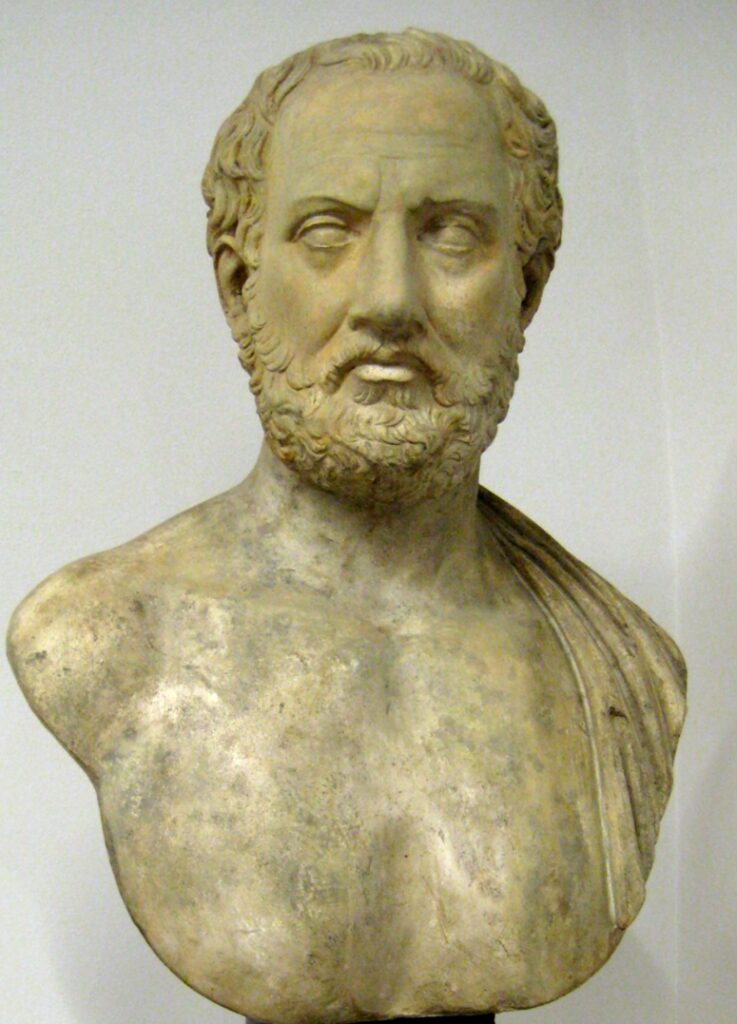
Who Was Thucydides?

0
Reading Time: 4 minutes

Thucydides (c. 460–c. 400 BCE) stands as one of the most influential thinkers of the ancient world—an Athenian historian, general, and analyst whose work shaped not only the study of history but the very foundations of modern international relations. Born in the Athenian deme of Halimous to a father named Olorus, who likely had Thracian aristocratic connections, Thucydides grew up in a world defined by the rise of Athenian power and the tensions that would soon erupt into the Peloponnesian War. Although little is known about his early life, later accounts suggest he may have encountered the historian Herodotus as a youth, an experience that supposedly stirred his passion for inquiry and historical writing.

Thucydides emerged into public life as a member of the Athenian elite, connected through family ties to influential figures such as Miltiades and Cimon. His wealth and status were further reinforced by his ownership of gold mines in Thrace, a resource that granted him both influence and strategic importance during the war between Athens and Sparta. When the Peloponnesian War broke out in 431 BCE, Thucydides was already old enough to grasp its significance and begin documenting its events with the meticulous eye of a soldier‑scholar.

His firsthand experience in the conflict would shape both his life and his intellectual legacy. In 424 BCE, he was elected stratēgos, a high-ranking military commander, and dispatched to defend the strategically vital city of Amphipolis. His failure to prevent its capture by the Spartan general Brasidas led to his exile from Athens for twenty years—a punishment that would ultimately become a gift to history. As Thucydides himself later wrote, exile granted him “leisure to observe affairs more closely” and the unique ability to move among both Athenian and Peloponnesian allies, gathering information from all sides of the conflict.

This dual perspective became the backbone of his monumental work, The History of the Peloponnesian War, a text that not only chronicled the conflict but revolutionized the practice of historical inquiry. Unlike Herodotus, who incorporated myth, divine causation, and cultural storytelling, Thucydides pursued what he called a “possession for all time”—a rigorous, evidence‑based account grounded in human motivations, political necessity, and the dynamics of power. For this reason, he is often called the “father of scientific history”.

Yet Thucydides’ influence extends far beyond historiography. He is widely regarded as the founding figure of political realism, the school of thought that views international politics as a struggle for power shaped by fear, self‑interest, and the pursuit of security. His analysis of the Peloponnesian War is not merely a narrative of battles but a profound exploration of how states behave under pressure, how leaders make decisions, and how power imbalances drive conflict.

One of the most famous examples of his realist insight is the Melian Dialogue, in which Athenian envoys bluntly assert that “the strong do what they can and the weak suffer what they must.” This stark articulation of power politics has become a foundational text in international relations theory, illustrating the logic of coercion, deterrence, and the tragic consequences of idealism in an anarchic world system. The dialogue remains required reading in military academies and political science programs worldwide.

Thucydides also offered a penetrating analysis of human nature, arguing that fear, honor, and interest—what later scholars would call the “Thucydidean triad”—drive both individuals and states into conflict. His account of the plague in Athens, the civil war in Corcyra, and the rise of demagogues like Cleon reveals how crises expose the darker impulses of human behavior, eroding norms and destabilizing political communities. These insights continue to inform contemporary discussions of war psychology, state collapse, and the fragility of democratic institutions.

His portrayal of Pericles, whom he admired as a model of prudent leadership, further underscores his contribution to political theory. Thucydides’ reconstruction of Pericles’ Funeral Oration remains one of the most studied speeches in Western literature, offering a vision of democratic values, civic duty, and national identity that continues to resonate today. At the same time, his critique of Athens’ later leaders highlights the dangers of populism, strategic overreach, and the erosion of disciplined statecraft.

Thucydides’ life after his exile remains obscure. Ancient sources suggest he may have returned to Athens after its defeat in 404 BCE, possibly due to a law passed by the statesman Oenobius, but the details are uncertain. His History ends abruptly in 411 BCE, leading scholars to conclude that he died before completing it, perhaps violently while traveling back to Athens.

Despite the gaps in his biography, Thucydides’ intellectual legacy is unmistakable. His work laid the groundwork for realist thinkers from Machiavelli to Hobbes to Hans Morgenthau. His insights into power transitions have shaped modern theories such as the “Thucydides Trap,” which examines the likelihood of war when a rising power threatens to displace an established one. His insistence on empirical observation, rational analysis, and the centrality of human nature continues to guide scholars, diplomats, and military strategists.

Thucydides sought to understand not only what happened in the Peloponnesian War but why it happened—and in doing so, he uncovered patterns of behavior that transcend time and culture. His work remains a mirror in which every generation can see its own struggles with power, fear, ambition, and the fragile pursuit of peace.

If you are interested in learning more about this topic, you will enjoy our podcast series, How the World Works, where we explore the field of International Relations. 

Theories of International Relations

0
theories of international relations
Reading Time: 2 minutes

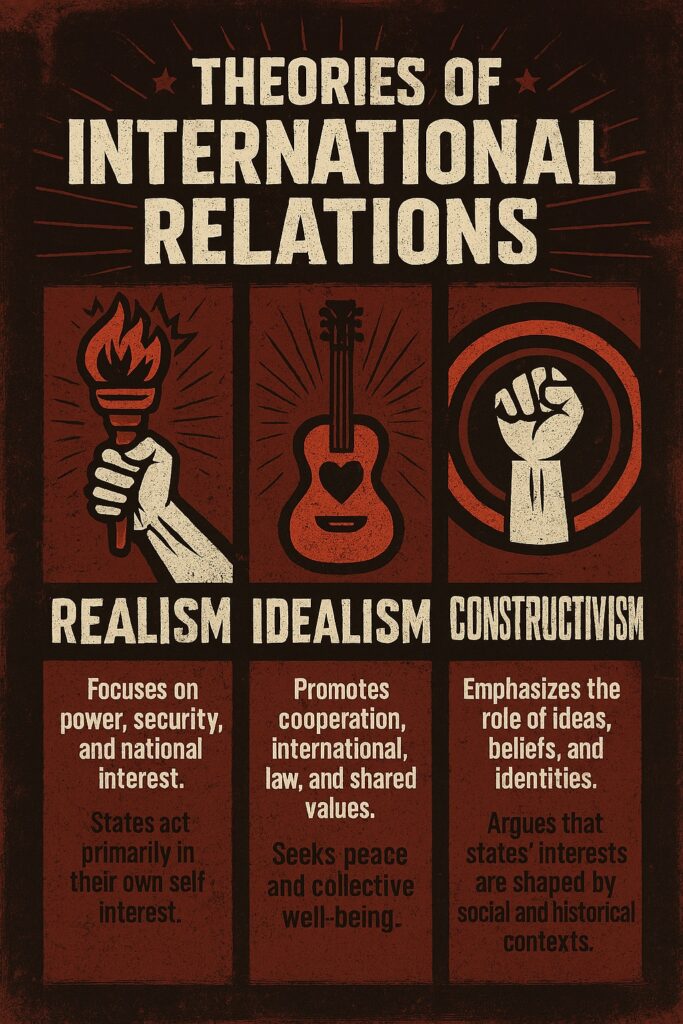
In this episode of our podcast, we dive deep into the foundational theories of international relations—Realism, Idealism, and Constructivism—and explore how they shape global decision-making, diplomacy, and conflict.

Members Can Access the Episode Here

We begin by unpacking the historical roots of the international system, often traced to the Peace of Westphalia. However, scholars like Amitav Acharya challenge this Eurocentric narrative, pointing to pre-Westphalian traditions in the Global South. This sets the stage for understanding how power and perspective influence the way we study global politics.

The episode then explores Realism, the dominant theory adopted by many Western policymakers, including Henry Kissinger. Realism views the world as anarchic and driven by self-interest, where states prioritize survival and power over moral values. We examine how this played out in the U.S.-backed coup in Chile, revealing the tension between democratic ideals and strategic interests.

Next, we turn to Idealism, which emphasizes cooperation, ethical principles, and the potential for peace through institutions like the United Nations. Rooted in Enlightenment thinking and championed by Woodrow Wilson, Idealism offers a hopeful vision—but one often criticized as naïve in times of war.

Finally, we explore Constructivism, which argues that global politics is shaped by ideas, identities, and social norms. With insights from Alexander Wendt, we discuss how perceptions and relationships redefine threats, alliances, and values over time.

Whether you’re a student, educator, or global affairs enthusiast, this episode offers a clear, engaging breakdown of the main theories of international relations—and how they continue to influence the world today.

Tune in now to explore how Realism, Idealism, and Constructivism reveal the deeper logic behind global events.


Everything That Glitters…

0
Reading Time: < 1 minute

Across eight international conflicts, the Trump administration has celebrated what it calls historic peace agreements. But when each case is examined more closely—from Armenia and Azerbaijan to India and Pakistan—the picture becomes far less straightforward. Some agreements resemble surrender more than peace. Others never halted fighting at all. Still others addressed no active war, only long‑standing tensions that remain unresolved. The episode traces these contradictions, not to score partisan points, but to illuminate a deeper worldview shaping U.S. actions on the global stage.

Rather than offering easy answers, the episode invites listeners to consider the deeper forces at work behind glittering announcements and triumphant ceremonies. It asks what history teaches us about power, intention, and the unforeseen consequences that follow bold, headline‑grabbing actions.

Read More

The Road to Westphalia

0
the road to westphalia
Reading Time: 2 minutes

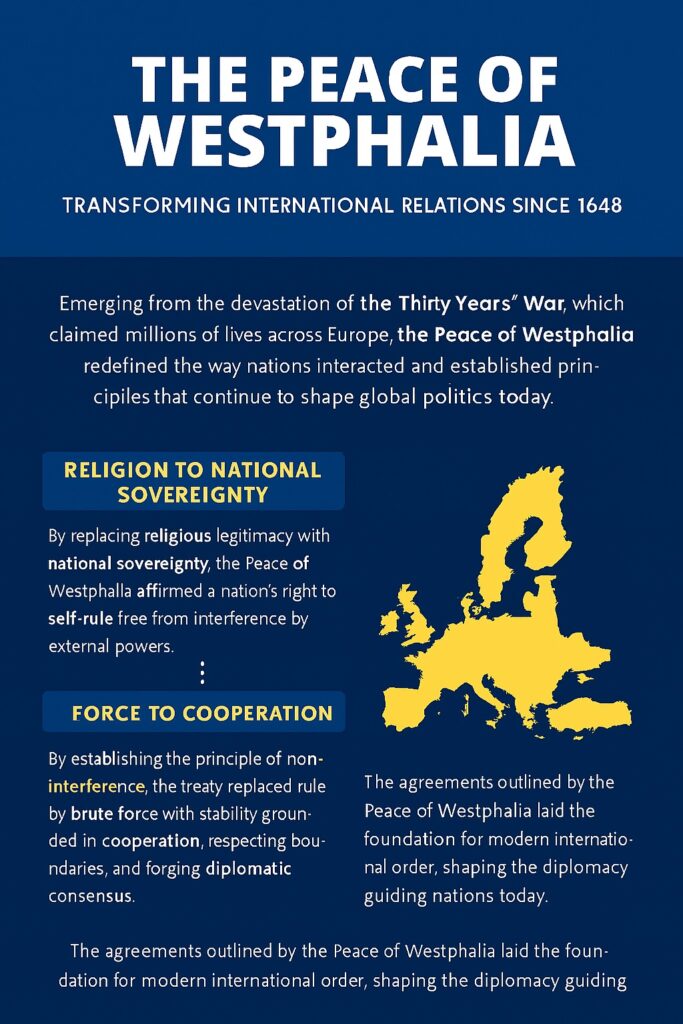
The Peace of Westphalia of 1648 stands as one of the most transformative milestones in the history of international relations. Emerging from the devastation of the Thirty Years’ War, which claimed millions of lives across Europe, the treaty redefined the way nations interacted and established principles that continue to shape global politics today.

Before the Peace of Westphalia, political authority was deeply intertwined with religious legitimacy. Empires and the Catholic Church often claimed supranational control, leading to endless conflicts over faith and power. The treaty broke from this tradition by affirming the sovereignty of individual states. Each nation gained the right to govern its territory without external interference, regardless of its religion or internal politics. This principle of national sovereignty and non-interference became the cornerstone of the modern international system.

The Peace of Westphalia also marked a shift from domination by brute force to cooperation through agreement. Nations recognized that stability could be achieved not only by military might but also by respecting boundaries and forging diplomatic consensus. This framework laid the foundation for centuries of European stability, enabling technological innovation, economic growth, and the eventual expansion of European influence across the globe.

Even today, the legacy of the Peace of Westphalia is evident. Modern institutions like the United Nations echo its principles, emphasizing respect for sovereignty and collective security. Violations of these norms—such as invasions without provocation—are condemned as breaches of the Westphalian order. From the wars of Hitler to the invasion of Ukraine, the rules established in 1648 remain central to global diplomacy.

Ultimately, thePeace of Westphaliawas more than a treaty; it was the birth of modern international relations. By pushing back anarchy and disorder, it created a system where nations could coexist, cooperate, and build a more stable world.


Take the Quiz Here


Become a Patreon Supporter to Access the Remaining Classes in this Course

great christian podcast on patreon

Our Modern Utopia and the Tyranny of Desire

0
Reading Time: 4 minutes

Mankind has long looked forward to a day when we might fulfill our every desire. In the 16th century, Thomas More’ Utopia pictured a society in which every person, regardless of station, was free to pursue happiness without obstruction. More envisioned a world where “Nobody owns anything, but everyone is rich – for what greater wealth can there be than cheerfulness, peace of mind, and freedom from anxiety?” In his imagined world social structures never hindered personal fulfillment. “Kindness and good nature,” he wrote, “unite men more effectually and with greater strength than any agreements whatsoever, since thereby the engagements of men’s hearts become stronger than the bond and obligation of words.” In such a world, the monsters of human nature would vanish and society would flourish.

At first glance, such a vision seems harmless – even noble. As I have mentioned in previous articles and Monday Morning Devotionals, the aim of philosophy is often to identify the surest path to happiness and fulfillment. And in many ways, our modern world resembles More’s dream. By historical standards, even the poor in modern industrialized societies live with comforts unimaginable in the 16th century. Though inequality persists, modern life has removed countless barriers between us and the fulfillment of our desires.

Our Modern Utopia

Technology has brought us closer than ever to a frictionless life. Groceries, clothing, and services arrive with a tap. Entertainment streams instantly into our hands. Social media connects us to strangers and friends alike, collapsing distance and time. And knowledge—true, false, or somewhere in between—is available on demand. We can curate our own truths, retreat into echo chambers, or wander into the wilderness of forbidden ideas whenever we choose.

This world has nurtured an ethos that elevates personal desire to the highest good. The philosophers of old have been replaced by self-help gurus and marketing strategists. Their slogans—crafted for an age of instant gratification—reduce life’s purpose to the pursuit of whatever we want in the moment.

  • Live your best life!
  • You do you!
  • Treat yourself!
  • You deserve it!
  • I did it my way!

Dangerous Desire

We are told that success requires the relentless pursuit of our desires. Motivational writer Napoleon Hill captured this ethos: “Desire is the starting point of all achievement, not a hope, not a wish, but a keen pulsating desire which transcends everything.”

Yet something has gone terribly wrong in our desire‑driven utopia. Rates of depression and anxiety have climbed. Escapism—whether through substances, entertainment, or even self‑harm—has surged. Our digital spaces overflow with anger and division. For all its comforts, the modern age is emotionally strained and spiritually impoverished.

Even as the ethos and glorification of our personal desires persist in popular culture, modern thinkers have challenged its very foundation. Albert Einstein noted, “A life directed chiefly toward the fulfillment of personal desires will sooner or later always lead to bitter disappointment.” Such sentiments do not align with the popular zeitgeist, nor do they sell products on social media or our favorite streaming show.

Scripture, however, speaks of desire with both hope and caution.

“For the wicked boasts of his heart’s desire;

He blesses the greedy and renounces the LORD.” —Psalms 10:3 (NKJV)

The word boasts here comes from the Hebrew halal, meaning “to celebrate,” “to make a show of,” or “to glory.” It evokes the same spirit behind our modern slogans—an entitlement that urges us to “treat yourself” without restraint.

Authorized Desire

God does not forbid desires. They are part of the beauty that makes us both human and distinct from one another. Yet there is an order and arrangement, a divinely authorized design, in which our desires must fit into our lives so that they enhance our lives rather than corrupt them.

Disordered desires eventually crush us. Some are blatantly destructive—sins so obvious they hardly need naming. They promise pleasure but leave behind guilt, regret, and brokenness. We know, or should know, to avoid them.

But other desires—wealth, status, achievement—appear harmless yet can be just as ruinous. We all know people, perhaps we have been those people, who chase a goal so relentlessly that everything else becomes collateral damage. Whether they reach the prize or not, the cost is often a trail of strained relationships and spiritual emptiness.

Whenever we hear of celebrities overdosing on drugs or of influential and eminent figures with children and families that are crumbling, I wonder whether they would trade what they gained for what they lost along the way. Do they even recognize the decision that took shape at some point in the privacy of their own souls: I will sacrifice this for that because that desire is the chief and most important thing of all. 

God’s design for human flourishing includes desire—but desire rightly placed. Within the architecture of a faithful life, personal longings have a place, but they are not the pinnacle. That place belongs to obedience and surrender to God’s will.

“Delight yourself also in the LORD,

And He shall give you the desires of your heart.” —Psalms 37:4 (NKJV)

When God is supreme in our worldview, His values, preferences, and priorities cascade into our own decisions and objectives. This almost always leads to a realignment of our personal desires, usually placing them at a lower priority than they might have held before a personal confrontation with the priorities of God. What once felt urgent often settles into its proper place beneath the priorities of God.

This is the path Christ calls us to walk: to deny ourselves, take up the cross, and follow Him. In the ordinary moments of life, we reveal whom we truly worship—God or our own desires. And in choosing Him, our hearts finally find the desires that endure.

This article was initially published as our Monday Morning Devotional.

How the World Works: Understanding International Relations

0
how the world works understanding international relations
Reading Time: 2 minutes

In today’s world of fake news, deep fakes, and endless bias, it’s harder than ever to know what’s true. Yet global events—from wars in Ukraine and Gaza to economic bailouts in Argentina—shape our daily lives, from grocery prices to retirement accounts. That’s why this new podcast series “How the World Works” is here: to cut through the noise and help listeners gain clarity by understanding international relations.

This 10-episode series offers a virtual curriculum that explores the rules, strategies, and philosophies nations use to navigate power, security, and prosperity. It’s not about partisan politics—it’s about learning the “language of Babylon,” the systems and theories that explain why nations act the way they do. Concepts like sovereignty, humanitarian intervention, regime change, and coalitions are unpacked so listeners can see the bigger picture behind the headlines.

What makes “How the World Works” unique is its integration of a Biblical worldview. Drawing inspiration from figures like the prophet Daniel, the series shows how faith and international relations intersect. Daniel thrived in chaotic times because he understood both God’s sovereignty and the world’s systems. Likewise, this podcast invites listeners to explore how divine principles align with global affairs, offering wisdom that transcends politics.

The first episodes are available publicly, while Patreon supporters gain access to exclusive content, quizzes, daily discussions, and the whole series. Whether you’re a student, a curious citizen, or someone seeking a deeper perspective, this series equips you to interpret global events with confidence and insight and a Kingdom worldview.

By the end of the journey, you won’t just know more about international relations—you’ll see the world differently, with a clearer understanding of both human systems and God’s hand in history.

Episode Listing

  1. The Road to Westphalia
  2. Theories of International Relations
  3. A Biblical Model
  4. The Pursuit of Power
  5. What Is a Nation?
  6. Self-Interests
  7. Ideology
  8. Case Studies (Japan, Russia, Taiwan)
  9. How Shall We Then Live
  10. How It Ends