

Long before Europeans set foot on the continent, long before the United States existed even as an idea, a powerful and sophisticated culture flourished in the heart of North America. Known today as the Mississippian Civilization, this vast network of cities, chiefdoms, and ceremonial centers dominated the landscape from roughly 800 to 1600 AD. Stretching from the Great Lakes to the Gulf Coast and from the Carolinas to Oklahoma, it was one of the most influential and complex civilizations ever to emerge in the Western Hemisphere.
At the center of this world stood Cahokia, the crown jewel of the Mississippian Civilization and the largest city north of Mesoamerica. Located just across the Mississippi River from present‑day St. Louis, Cahokia was a sprawling metropolis of earthen pyramids, plazas, wooden palisades, and neighborhoods filled with artisans, farmers, priests, and political elites. At its peak between 1050 and 1200 AD, Cahokia supported a population of 15,000 to 20,000 people—larger than London at the same time. For centuries, it was the beating heart of a continent.
A Civilization Built on Earth and Sky
The Mississippian Civilization is best known for its monumental earthen mounds—massive, hand‑built structures that served as temples, elite residences, burial sites, and ceremonial platforms. These mounds were architectural feats requiring millions of baskets of soil carried by human labor. No draft animals, no wheels, no metal tools—just organization, engineering knowledge, and sheer determination.
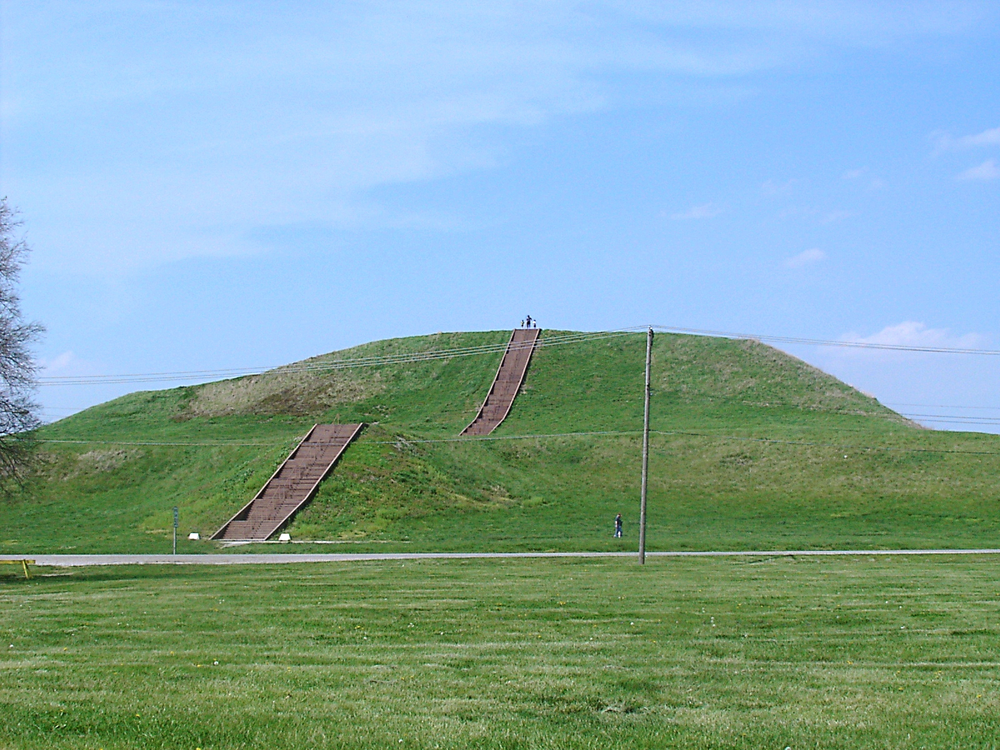
Cahokia’s Monks Mound remains the largest earthen structure in North America. Rising about 100 feet and covering more than 15 acres, it is roughly the size of the Great Pyramid of Giza’s base. Archaeological studies show that Monks Mound was built in multiple stages, with carefully layered soils and clays that reveal a sophisticated understanding of construction and drainage. Atop the mound once stood a massive wooden building—likely the residence or temple of Cahokia’s ruling chief, a figure who combined political, religious, and astronomical authority.
The Mississippian world was deeply attuned to the cosmos. Cahokia featured a wooden solar calendar known today as Woodhenge, a ring of tall posts aligned with solstices and equinoxes. Across the civilization, plazas and mounds were oriented to celestial events, reinforcing the power of priestly elites who claimed to mediate between the heavens and the earth.
Agriculture, Trade, and Power
The Mississippian Civilization was built on the foundation of maize agriculture. Corn, beans, and squash—often called the “Three Sisters”—supported dense populations and allowed for specialized labor. Farmers produced surpluses that fed artisans, priests, warriors, and rulers.
Trade networks stretched thousands of miles. Archaeologists have found:
- Copper from the Great Lakes
- Shells from the Gulf Coast
- Mica from the Appalachian Mountains
- Obsidian from the Rocky Mountains
- Exotic minerals and finely crafted pottery
These goods flowed into Cahokia and other major centers, where they were transformed into ritual objects, elite regalia, and symbols of power.
Mississippian society was hierarchical. At the top were powerful chiefs who claimed divine authority, supported by priests and nobles. Below them were farmers, laborers, and artisans who sustained the system. Some mounds contain elaborate burials filled with shell beads, copper ornaments, and ceremonial objects. Others contain evidence of human sacrifice—grim reminders of the spiritual and political power wielded by the elite.
A Continent of Cities and Cultures
While Cahokia was the largest and most influential center, it was not alone. The Mississippian Civilization included dozens of major sites and hundreds of smaller towns and villages. Places like Moundville in Alabama, Etowah in Georgia, Spiro in Oklahoma, and Angel Mounds in Indiana each developed their own regional styles and political structures.
These communities shared a common cultural language—mound building, maize agriculture, shell‑tempered pottery, and a complex iconography known as the Southeastern Ceremonial Complex. This artistic tradition featured falcons, serpents, warriors, and cosmic beings, reflecting a worldview that blended warfare, fertility, astronomy, and myth.
Decline and Transformation
By the 1300s, Cahokia began to unravel. A combination of factors likely contributed:
- Climate change, including prolonged droughts
- Resource depletion, especially timber
- Internal conflict and social upheaval
- Flooding from the Mississippi River
- Disease (possibly pre‑Columbian, possibly not)
By the time Europeans arrived in the 1500s, Cahokia had been abandoned for more than a century. But the Mississippian Civilization did not disappear. Its descendants lived on in the tribes of the Southeast and Midwest—the Choctaw, Chickasaw, Creek, Natchez, Osage, and many others. Their oral traditions, agricultural practices, and ceremonial customs carried echoes of the ancient mound‑building world.
Why the Mississippian Civilization Matters
The story of Cahokia and the Mississippian Civilization challenges the old myth that North America was a sparsely populated wilderness before European contact. Instead, it reveals a continent filled with cities, engineers, astronomers, farmers, and political leaders—people who built monumental landscapes and shaped the environment with skill and intention.
It also reminds us that civilizations rise and fall everywhere. Cahokia’s trajectory mirrors that of ancient Egypt, Mesopotamia, and Rome: growth, complexity, inequality, environmental stress, and eventual transformation.
Most importantly, the Mississippian Civilization is part of the American story. Its legacy is written into the land itself—in the mounds that still rise from the earth, in the descendants who carry its traditions, and in the rediscovered history that continues to reshape our understanding of the past.