
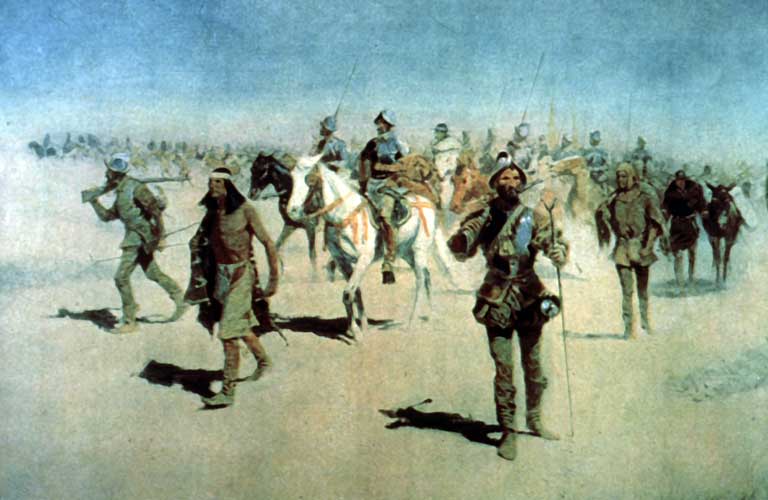
Francisco Vázquez de Coronado was born around 1510 in Salamanca, Spain, into a noble but not wealthy family. As a younger son, he would not inherit his family’s estate, a reality that pushed many ambitious young Spaniards toward the New World. Coronado grew up in a Spain energized by exploration, conquest, and the promise of riches across the Atlantic. In 1535, at about age twenty‑five, he traveled to New Spain (modern Mexico) in the entourage of Antonio de Mendoza, the first viceroy and a family acquaintance.
Coronado quickly proved himself capable in colonial administration. Within a few years, he married Beatriz de Estrada, the daughter of a powerful colonial treasurer, gaining both wealth and political influence. His success continued: in 1538 he was appointed governor of Nueva Galicia, a frontier province in northwestern Mexico. It was from this position that Coronado stepped into the world of legend.
In 1539, Fray Marcos de Niza returned from an exploratory mission to the north with astonishing claims. He reported seeing the **Seven Cities of Cíbola**, supposedly glittering with gold and wealth beyond imagination. These stories—rooted in Indigenous pueblos but inflated by rumor—captured the imagination of Spanish officials. Viceroy Mendoza authorized a massive expedition, placing Coronado in command.
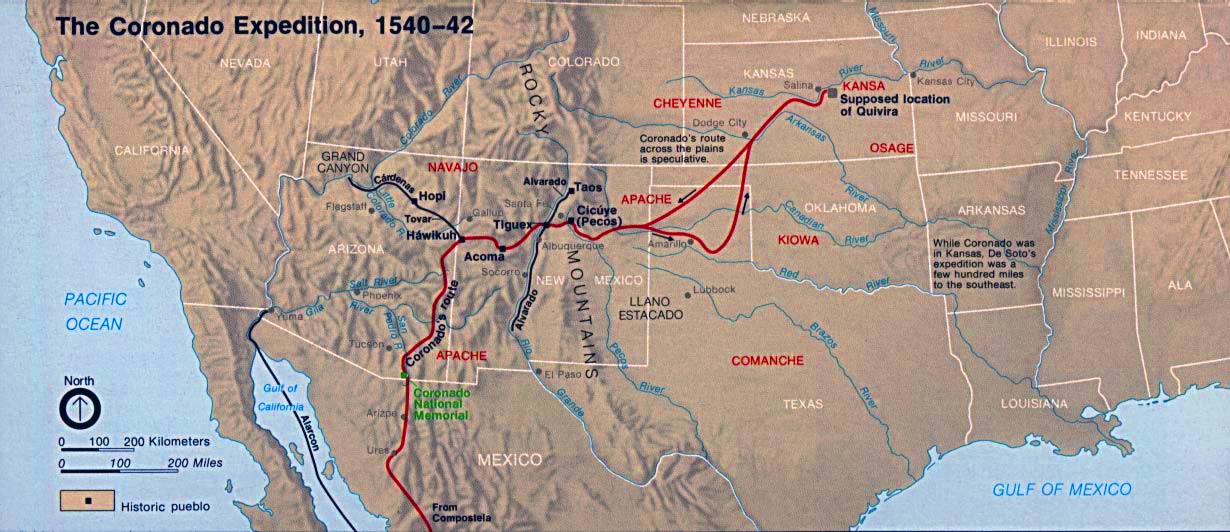
In 1540, Coronado led one of the largest overland expeditions of the era: about 300 Spaniards, hundreds of Indigenous allies and enslaved people, livestock herds, and a supporting naval contingent under Hernando de Alarcón. The expedition marched north through western Mexico into what is now Arizona and New Mexico. When Coronado reached Cíbola—actually the Zuni Pueblo of Hawikuh—he found not golden cities but stone villages. Disappointed but undeterred, he continued exploring.
Coronado’s expedition became the first group of Europeans to record several major landmarks of the American Southwest. A side party led by García López de Cárdenas reached the **Grand Canyon**, becoming the first Europeans to see it. Coronado himself traveled across the Rio Grande region, wintering near present‑day Santa Fe, where conflicts with local tribes erupted into violence and harsh reprisals.
Still chasing rumors of wealth, Coronado pushed farther onto the Great Plains. In 1541, guided by Plains Indians, he journeyed into what is now Kansas in search of **Quivira**, another supposed land of riches. Instead, he found a modest settlement of the Wichita people—no gold, no treasure, only the vast grasslands of the interior.
After two years of hardship, battles, and disappointment, Coronado returned to Mexico in 1542. His expedition, though historically significant, was deemed a failure by colonial authorities because it produced no wealth. Coronado resumed his governorship but never regained his earlier prestige. He died in Mexico City on September 22, 1554, at about age forty‑four.
Though he failed to find the mythical cities he sought, Coronado’s journey transformed European understanding of North America. His expedition mapped enormous stretches of the Southwest and Great Plains, recorded dozens of Indigenous cultures, and opened the region to future Spanish exploration. His legacy is one of ambition, endurance, and the enduring power of myth to shape history.