
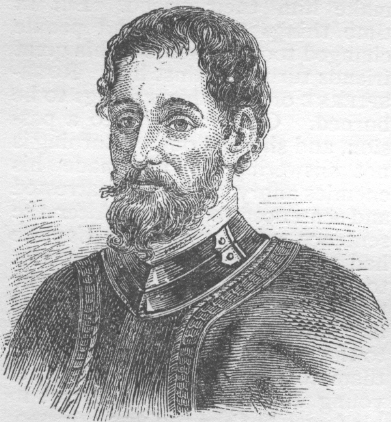
Hernando de Soto was born around 1496 in Jerez de los Caballeros, in the Extremadura region of southwestern Spain—a land of rugged hills, poor soil, and hardened ambition. Like many young men of his generation, de Soto grew up in a world shaped by the Reconquista and the promise of glory in the New World. His family belonged to the lesser nobility, and though they had honor, they lacked wealth. From an early age, de Soto dreamed of fortune and fame beyond Spain’s borders.
At age 14, he left for Seville and joined the 1514 expedition of Pedro Arias Dávila to the West Indies. In Panama and Nicaragua, de Soto quickly distinguished himself as a skilled horseman, trader, and soldier. He made his fortune through slave trading and military ventures, partnering with figures like Hernán Ponce de León and Francisco Campañón. By the early 1520s, he was one of the wealthiest men in Nicaragua, known for his daring and ruthlessness.
De Soto’s ambition led him to Peru, where he became a key figure in one of the most consequential conquests of the 16th century. In 1532, he joined Francisco Pizarro’s expedition against the Inca Empire. De Soto was the first Spaniard to meet the Inca emperor Atahualpa, and he played a central role in the Battle of Cajamarca, where Spanish forces captured Atahualpa and seized vast amounts of gold and silver. De Soto’s military skill and diplomatic tact earned him respect, and he became Pizarro’s chief lieutenant during the campaign.
Though the conquest of Peru brought him immense wealth, de Soto sought more than gold—he wanted command. In 1536, he returned to Spain, married Isabel de Bobadilla, and lobbied for his own expedition. The Spanish Crown granted his request, appointing him governor of Cuba and giving him permission to explore and conquer La Florida, a vast and largely unknown territory that included much of the southeastern United States.
In 1539, de Soto launched one of the most ambitious expeditions in the history of the Americas. With nine ships, over 600 men, and dozens of horses, he landed near present-day Tampa Bay, Florida. His goal was to find gold, establish colonies, and discover a passage to the Pacific Ocean. What followed was a grueling, three-year journey through Florida, Georgia, the Carolinas, Tennessee, Alabama, Mississippi, and Arkansas.
De Soto’s expedition was marked by violence, hardship, and cultural collision. He and his men fought numerous battles with Indigenous tribes, often using brutal tactics. They captured Native Americans to serve as guides and porters, and at times abducted women for their troops. The Spaniards brought European diseases that devastated local populations, though they did not understand the biological consequences of their presence.
Despite the suffering and setbacks, de Soto achieved one monumental feat: in 1541, he became the first European to document and cross the Mississippi River. He called it the “Rio Grande” for its immense size, though the name “Mississippi”—derived from Native languages—would later prevail. This moment symbolized both the ambition and the audacity of his expedition. De Soto had penetrated deeper into North America than any European before him.
Yet the journey took a toll. The expedition found no gold, no passage to the Pacific, and no lasting colony. Disease, starvation, and conflict decimated his ranks. In 1542, Hernando de Soto died near the banks of the Mississippi River—likely in present-day Louisiana or Arkansas. To conceal his death from hostile tribes, his men buried him in the river’s depths, hoping to preserve the illusion of his immortality.
De Soto’s legacy is complex. He was a brilliant tactician and fearless leader, but also a symbol of the violent collision between European ambition and Indigenous resistance. His expedition mapped vast regions of North America, provided invaluable geographic and ethnographic data, and opened the door to future colonization. Yet it also left a trail of suffering, displacement, and death.
Historians debate whether de Soto’s journey was a failure or a triumph. He did not find the riches he sought, nor did he establish a lasting settlement. But he expanded the boundaries of European knowledge and demonstrated the scale and diversity of the continent. His journals and accounts—recorded by survivors and later chroniclers—offer a vivid portrait of early encounters between civilizations.
In Spain, de Soto was remembered as a hero. His widow, Isabel de Bobadilla, governed Cuba in his absence, becoming one of the first female colonial governors in the Americas. His name was later given to counties, cities, and landmarks across the United States, including DeSoto County in Mississippi and the De Soto National Forest.
More than five centuries later, Hernando de Soto remains a figure of fascination and controversy. He embodied the spirit of exploration, the hunger for glory, and the tragic consequences of conquest. His journey across the American South was one of the longest and most arduous in the Age of Exploration—a testament to human endurance, ambition, and the high cost of empire.