


Christian dispensationalism is one of the most influential theological systems to emerge from the modern evangelical world. For millions of Christians, it provides the framework through which they understand biblical prophecy, the relationship between Israel and the Church, and the events surrounding the return of Christ. Yet, despite its popularity in many evangelical circles, dispensationalism is a relatively recent development in the history of Christian theology. It represents a significant departure from the ways most Christians interpreted Scripture for nearly eighteen centuries. Understanding where dispensationalism came from, why it spread so rapidly, and how it differs from earlier Christian doctrine helps explain many of the debates that continue within the Church today.
Although many of the themes found in dispensationalism have older precedents, the theological system itself emerged during the nineteenth century. Its principal architect was John Nelson Darby (1800–1882), an Anglo-Irish minister and one of the founders of the Plymouth Brethren movement. Darby developed a comprehensive approach to biblical interpretation that divided God’s dealings with humanity into a series of distinct “dispensations” or administrations. In each dispensation, God tested humanity in a unique way while progressively revealing His plan of redemption.

Darby’s most distinctive contribution was his sharp distinction between Israel and the Church. In his view, God had two parallel peoples with two distinct destinies. Israel retained earthly promises centered on land and national restoration, while the Church possessed heavenly promises. This distinction shaped virtually every aspect of his theology, including his understanding of prophecy, the millennium, and the return of Christ.
The rise of dispensationalism coincided with the religious ferment of the Second Great Awakening. The revival movements of the early nineteenth century created enormous interest in biblical prophecy and the expectation that God was moving history toward a dramatic climax. America became fertile ground for prophetic conferences, Bible institutes, and movements that emphasized the imminent return of Christ. While Darby himself was British, his repeated visits to North America helped popularize his teachings among American evangelicals.
Another major factor in the spread of dispensationalism was the publication of the Scofield Reference Bible in 1909. Compiled by Cyrus Ingerson Scofield, this study Bible placed dispensational interpretations directly alongside the biblical text. For many readers, the explanatory notes became almost inseparable from Scripture itself. Bible institutes such as the Moody Bible Institute and later Dallas Theological Seminary trained generations of pastors who adopted and promoted this theological framework. By the middle of the twentieth century, dispensationalism had become one of the dominant perspectives within conservative American evangelicalism.

Yet this theological system represented a significant break from earlier Christian doctrine. Throughout the writings of the early Church Fathers, medieval theologians, the Protestant Reformers, and the major confessional traditions, Christians generally viewed the Church as the continuation and fulfillment of God’s covenant people. Although these traditions disagreed on many matters—including the nature of the millennium—they overwhelmingly affirmed the unity of God’s redemptive plan. The Church did not replace Israel in the sense of nullifying God’s faithfulness, but believing Jews and Gentiles together formed one people united in Christ.
This understanding draws heavily from passages such as Ephesians 2, where Paul describes Christ breaking down the dividing wall between Jew and Gentile, creating “one new man.” Likewise, Galatians 3 teaches that those who belong to Christ are Abraham’s offspring and heirs according to the promise. Earlier Christian theologians generally understood these passages to mean that the promises given to Israel ultimately find their fulfillment in Jesus Christ and in His people, rather than remaining permanently divided between two separate covenant communities.
Dispensationalists, however, argue that these passages should not erase God’s unique future purposes for ethnic Israel. They emphasize a consistently literal interpretation of Old Testament prophecy and maintain that national Israel will experience a future restoration distinct from the Church.
Nevertheless, critics identify several weaknesses within the system. One concern is that it can divide the biblical story into compartments that obscure the continuity of God’s covenant purposes. Scripture often presents redemption as one unfolding story centered on Christ rather than a series of disconnected eras. The New Testament repeatedly points back to Jesus as the fulfillment of God’s promises to Israel, suggesting greater unity than dispensationalism sometimes allows.
A second concern involves the relationship between Israel and the Church. By maintaining two distinct peoples of God, critics argue that dispensationalism can unintentionally weaken the New Testament emphasis on the unity of believers in Christ. The apostles consistently portray the gospel as bringing Jews and Gentiles together into one body under one Savior.
A third criticism concerns biblical interpretation. While dispensationalism emphasizes literal readings of prophetic texts, critics note that the New Testament authors frequently interpret Old Testament promises in ways that transcend their original national context. The apostles often apply Israel’s language to Christ and His Church, suggesting that biblical fulfillment is richer and more Christ-centered than a purely literal reading might anticipate.
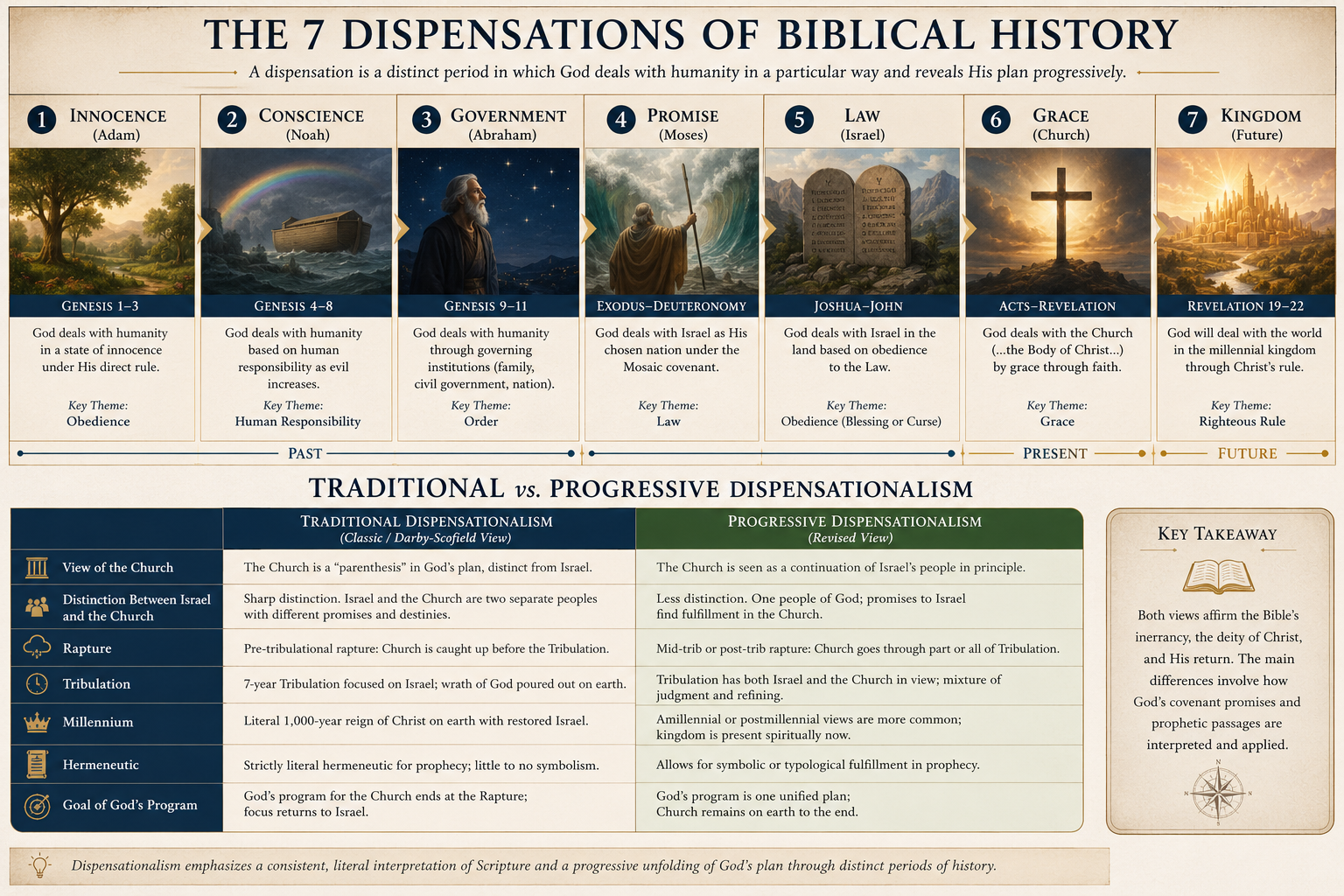
These theological differences have also produced significant practical consequences within modern Christianity. Perhaps the most recognizable is the widespread expectation of a pre-tribulation rapture, in which Christ secretly removes the Church before a seven-year tribulation. Although many sincere Christians hold this belief, it was virtually unknown as a formal doctrine throughout most of church history before the nineteenth century. Earlier Christians certainly anticipated Christ’s return, but they generally did not distinguish it into separate stages involving a secret removal of believers.
Dispensationalism has also contributed to an intense fascination with biblical prophecy. Entire industries of books, films, conferences, and television programs have attempted to connect current events with end-times predictions. While this has encouraged many believers to study Scripture carefully, it has sometimes fostered speculative date-setting, sensational interpretations of world events, and recurring predictions that later proved mistaken.
Another byproduct has been the close connection between theology and modern geopolitics. Because dispensationalism assigns prophetic significance to the modern nation of Israel, many Christians view developments in the Middle East through an explicitly prophetic lens. Support for Israel can arise from many moral, historical, and political considerations, but dispensational theology has undoubtedly shaped how many evangelicals interpret contemporary events.
Finally, dispensationalism has sometimes encouraged a pessimistic view of culture. If history is expected to decline inevitably until Christ returns, Christians may become less inclined to invest in long-term cultural renewal, education, or social reform. This is not true of every dispensationalist—many have served faithfully in missions, education, and humanitarian work—but critics argue that certain expressions of the system can unintentionally promote withdrawal rather than sustained cultural engagement.
Despite these disagreements, it is important to remember that dispensationalism exists within the family of orthodox Christianity. Christians who embrace or reject it affirm together the authority of Scripture, the deity of Christ, His atoning death and bodily resurrection, and His promised return. The debate concerns not whether Christ will return, but how the biblical story should be understood as it moves toward that glorious conclusion.