

Alexander Hamilton rose from obscurity in the Caribbean to become one of the indispensable architects of the United States. As George Washington’s trusted aide during the Revolutionary War, the nation’s first secretary of the treasury, and the chief designer of America’s financial system, Hamilton possessed a brilliance that few of his contemporaries could match. Yet his remarkable career was undone not by a political defeat or military failure, but by one of the first great sex scandals in American history. Within a few years, his reputation lay in tatters, and an old political rivalry culminated in a duel that claimed his life.
The scandal that shattered Hamilton’s political future began in the summer of 1791. At the height of his influence in President Washington’s cabinet, Hamilton encountered Maria Reynolds, a young woman who claimed her husband had abandoned her and that she desperately needed financial assistance. Hamilton later admitted that what began as an act of sympathy quickly became an illicit affair.
The relationship continued for nearly a year, but it was never simply a romance. Maria’s husband, James Reynolds, soon learned of the affair—or perhaps had orchestrated it from the beginning. Rather than expose Hamilton immediately, Reynolds demanded money in exchange for his silence. Hamilton repeatedly paid him, believing that preserving his family’s reputation was worth almost any cost. In effect, the nation’s treasury secretary found himself being blackmailed.
The payments soon attracted attention. Political opponents investigating James Reynolds for financial crimes discovered evidence of money flowing from Hamilton to Reynolds. Among Hamilton’s fiercest rivals, including Thomas Jefferson, James Madison, and James Monroe, suspicion arose that the treasury secretary was secretly diverting government funds for personal speculation.
When confronted privately in 1792, Hamilton made an extraordinary decision. Rather than allow accusations of public corruption to stand, he confessed to the affair with Maria Reynolds and produced letters proving that the payments had been hush money rather than stolen government funds. His political enemies agreed not to publish the information at the time, recognizing that while Hamilton had demonstrated grave moral failure, he had successfully disproven charges of financial corruption.
For several years the matter remained largely hidden. But in 1797, journalist James Thomson Callender published allegations that Hamilton had engaged in financial misconduct. Determined to clear his name once and for all, Hamilton made one of the most astonishing choices in American political history. He published a ninety-five-page pamphlet—later known simply as the Reynolds Pamphlet—that laid bare every humiliating detail of his adultery.
Hamilton believed the public would rather forgive a private moral failing than believe he had betrayed the nation’s finances. In one sense, his gamble succeeded. Few continued to accuse him of embezzling public money. Yet the price was enormous. He publicly destroyed his own moral reputation, humiliated his wife Elizabeth Schuyler Hamilton, and provided political opponents with endless ammunition. Even supporters struggled to understand why Hamilton had volunteered such intimate details to the public.
The scandal permanently damaged his prospects for higher office. In an era that prized personal honor, Hamilton’s confession made it virtually impossible for him to aspire to the presidency. Though he remained one of the Federalist Party’s intellectual leaders, his political influence steadily declined. The man who had shaped the nation’s finances found himself increasingly isolated from the centers of power he had helped create.
Personal tragedy compounded his political decline. In 1801 Hamilton’s eldest son, Philip, fought a duel while defending his father’s honor against public insults. Only nineteen years old, Philip was mortally wounded. Hamilton never fully recovered from the loss. Friends noticed a profound sadness that lingered over him during his remaining years.
Hamilton’s final chapter grew from another bitter political conflict. The presidential election of 1800 had already intensified divisions within the Federalist Party. Hamilton openly criticized President John Adams, weakening his own party, while also opposing Thomas Jefferson’s rival, Aaron Burr, whom Hamilton considered dangerously ambitious and devoid of principle. Four years later, Burr sought the governorship of New York. Hamilton quietly worked behind the scenes to prevent Burr’s election, reportedly describing him in deeply unflattering terms.
After Burr lost, he demanded an explanation and insisted Hamilton either deny making disparaging remarks or apologize. Hamilton refused to retract statements that reflected his genuine opinion while also declining to specify every conversation in which he had criticized Burr. In the culture of honor that dominated elite American society, Burr regarded Hamilton’s response as unacceptable and challenged him to a duel.
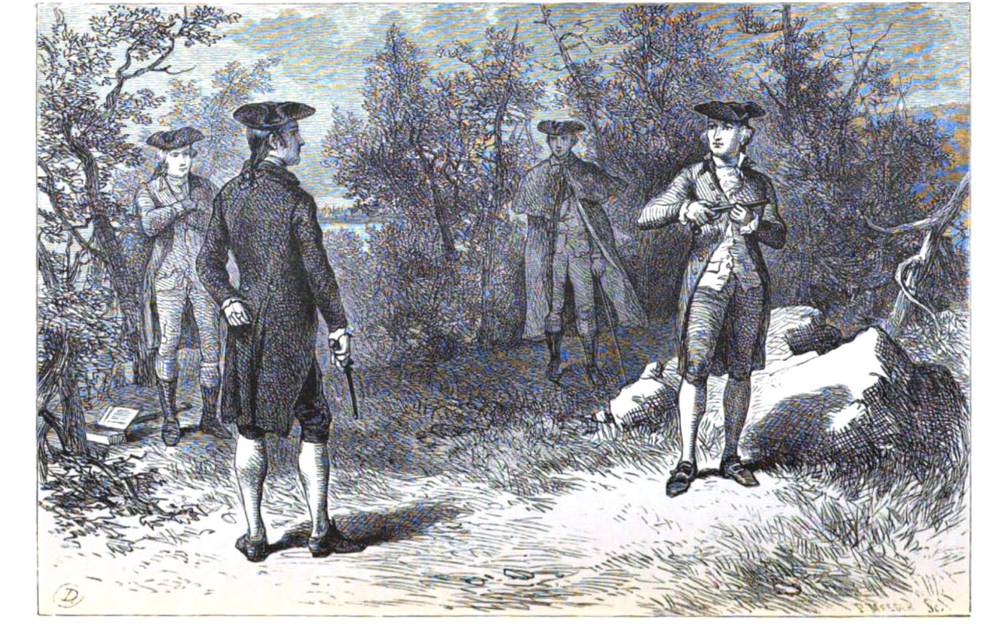
The duel took place on July 11, 1804, at Weehawken, New Jersey, across the Hudson River from New York City. Ironically, it was the very location where Hamilton’s son had been killed three years earlier.
Hamilton had expressed to several friends and family members that he intended, if possible, to reserve his fire or deliberately miss Burr. Whether from religious conviction, moral reflection, or concern for his family, he believed dueling was wrong but felt social expectations left him little room to refuse the challenge. When the moment came, Hamilton’s pistol discharged high into the trees. Burr, however, fired directly at Hamilton, striking him in the abdomen. The bullet shattered his liver and spine, inflicting wounds from which no physician of the era could save him.
Hamilton was carried back across the river to New York, where he lingered for roughly thirty-one hours. Surrounded by family, friends, and clergy, he expressed deep concern for his wife and seven surviving children. Before dying on July 12, 1804, at the age of forty-nine, Hamilton reportedly sought spiritual comfort and reconciliation with God.
His funeral drew thousands of mourners. Political allies and even former opponents recognized that the young republic had lost one of its greatest minds. Yet Hamilton’s death also symbolized the end of an era. The fierce personal rivalries that had characterized the nation’s founding generation had exacted an extraordinary price.
Alexander Hamilton’s downfall was ultimately shaped by two very different failures. His affair with Maria Reynolds exposed a profound lapse in personal judgment that crippled his political future. His duel with Aaron Burr reflected a culture of honor that prized reputation above life itself. Together, these events transformed one of America’s most gifted founders from a towering statesman into a tragic figure—a man whose extraordinary achievements endured, even as his personal flaws hastened his ruin.