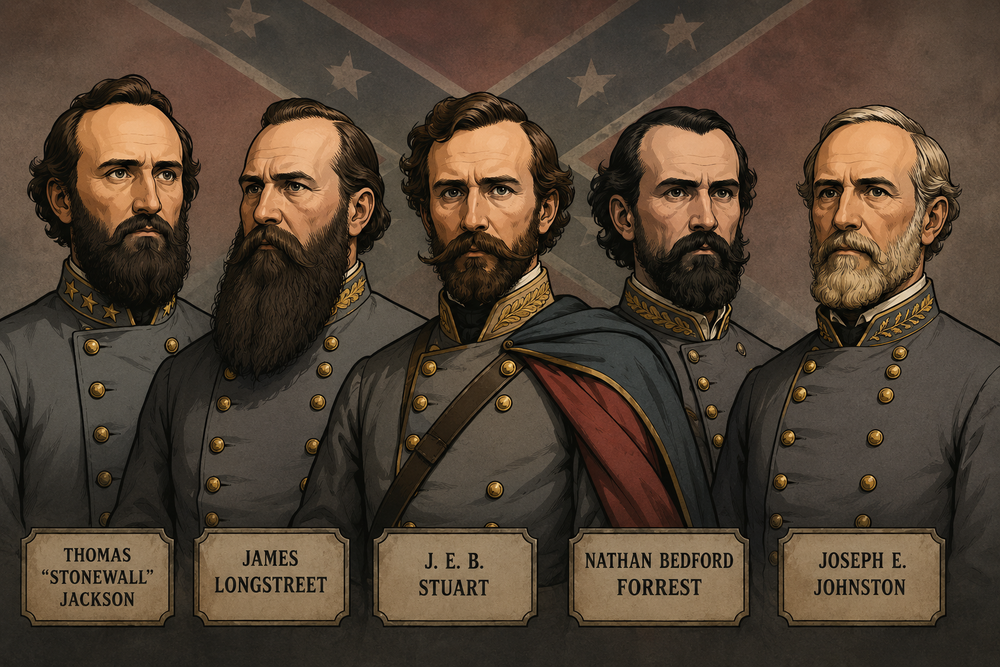
Before Robert E. Lee came to symbolize the Confederate war effort, and even while he commanded the Army of Northern Virginia, a number of other generals emerged whose names became synonymous with Southern military history. They differed greatly in personality and ability. Some were brilliant tacticians, others gifted cavalry leaders, and still others were remembered more for controversy than success. Together they helped shape the course of the Civil War and left a lasting imprint on the historical memory of the Confederacy.
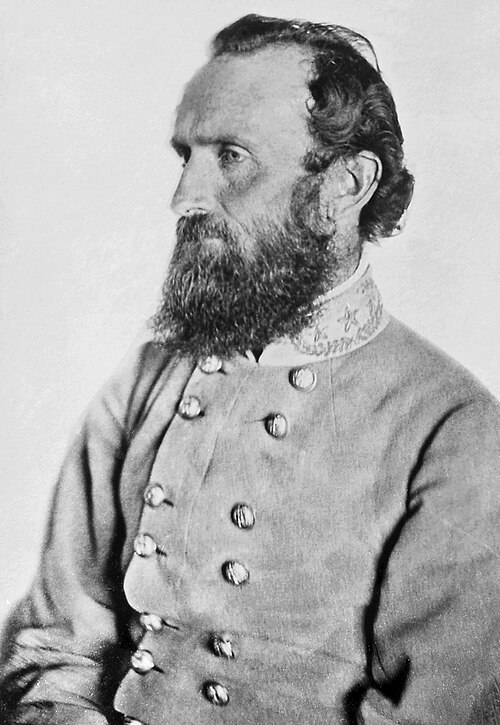
Among them, no Confederate general has achieved greater legendary status than Thomas Jackson. Born in the mountains of western Virginia in 1824, Jackson overcame a childhood marked by poverty and the deaths of several family members. Through relentless determination, he earned an appointment to the United States Military Academy at West Point, where he graduated despite beginning his education with significant disadvantages. Before the Civil War, Jackson served with distinction in the Mexican-American War and later became a professor at the Virginia Military Institute.
Jackson earned the nickname “Stonewall” during the First Battle of Bull Run in 1861, when General Barnard Bee reportedly declared that Jackson was standing “like a stone wall” against Union attacks. Whether Bee intended the phrase as praise or criticism remains debated, but the name became inseparable from Jackson’s legend. Deeply religious and known for his disciplined lifestyle, Jackson believed that every event was governed by God’s providence. His bold marches and surprise attacks repeatedly bewildered Union commanders. His 1862 Shenandoah Valley Campaign, in which he marched his small army hundreds of miles while defeating several larger Union forces, is still studied in military academies as a masterpiece of maneuver warfare. His career ended tragically after the Battle of Chancellorsville in 1863, when he was accidentally shot by Confederate soldiers during a nighttime reconnaissance. He died from complications days later, a loss many historians believe permanently weakened the Confederacy.
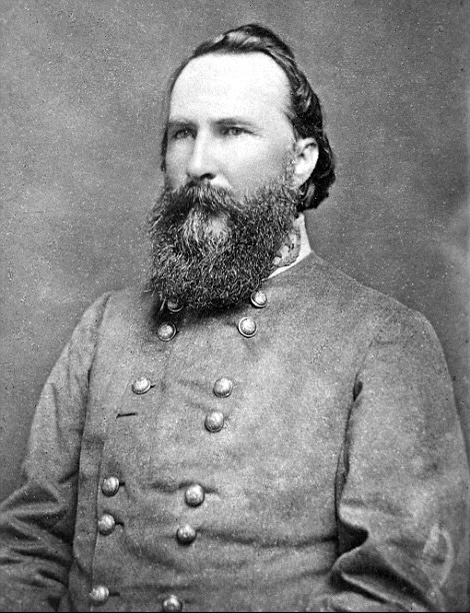
Another legendary Confederate commander was James Longstreet. Unlike Jackson’s aggressive style, Longstreet excelled in defensive warfare. A graduate of West Point and a veteran of the Mexican-American War, Longstreet became one of the Confederacy’s most dependable corps commanders. Calm, practical, and remarkably steady under pressure, he played key roles in victories at Second Bull Run, Antietam, Fredericksburg, and Chickamauga. At Fredericksburg in particular, his carefully prepared defensive positions inflicted devastating casualties on repeated Union assaults.
Longstreet remains one of the Civil War’s most controversial figures because of the Battle of Gettysburg. After the war, many supporters of the “Lost Cause” movement unfairly blamed him for the Confederate defeat, arguing that he had failed to carry out Lee’s plans enthusiastically. Modern historians largely reject those accusations, noting that Longstreet had actually argued against the disastrous frontal assault known as Pickett’s Charge and favored a more defensive strategy. After the war, his decision to cooperate with Reconstruction and join the Republican Party made him unpopular among many former Confederates, further damaging his reputation for generations.

The Confederacy’s most celebrated cavalry commander was J. E. B. Stuart. Born in Virginia in 1833, Stuart graduated from West Point and quickly gained a reputation as an energetic horse soldier. His colorful appearance, complete with a plumed hat, flowing cape, and bright sash, reflected his dramatic personality. Stuart became famous for daring cavalry raids that circled entire Union armies, gathering intelligence while disrupting enemy communications and supply lines.
Stuart’s cavalry provided invaluable reconnaissance during many Confederate campaigns. However, his reputation suffered because of his controversial absence during the opening days of the Gettysburg Campaign. While conducting an ambitious raid around the Union Army, Stuart lost contact with Confederate headquarters, leaving Lee without reliable intelligence about Union troop movements. Although Stuart later fought courageously during the battle, many historians believe his absence contributed to Confederate confusion before Gettysburg. Stuart was mortally wounded during the Battle of Yellow Tavern in 1864 and died at only thirty-one years of age.
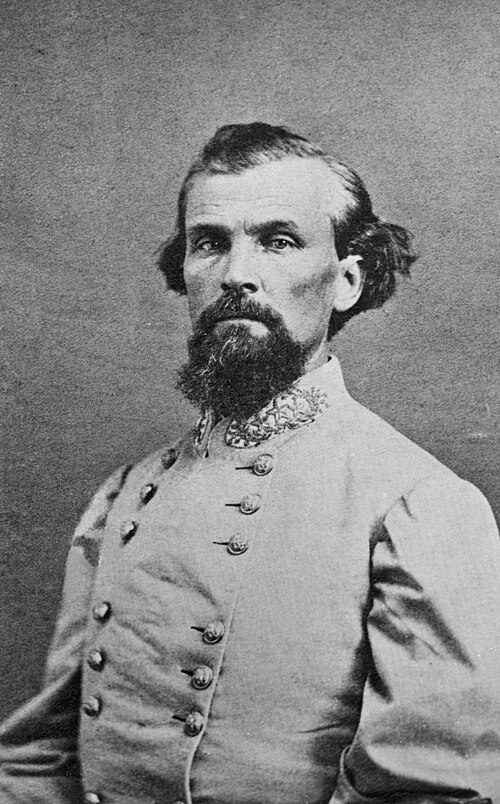
Perhaps no Confederate general inspired more fear than Nathan Bedford Forrest. Unlike most senior officers, Forrest had no formal military education. A wealthy Tennessee businessman before the war, he enlisted as a private but quickly raised his own cavalry unit and rose rapidly through the ranks because of his exceptional leadership and battlefield success. Forrest made his pre-war fortune primarily through the interstate slave trade, cotton planting, and livestock speculation. By the start of the Civil War, he had accumulated an estimated fortune of $1.5 million, making him one of the wealthiest men in the South.
Forrest possessed extraordinary instincts for mobile warfare. His famous maxim, often summarized as “get there first with the most men,” reflected his ability to concentrate forces rapidly at decisive points. He consistently defeated larger Union forces through speed, surprise, and aggressive action. Many military historians consider him one of history’s greatest cavalry commanders. However, Forrest’s legacy remains deeply controversial because Confederate troops under his command massacred surrendering Black Union soldiers at Fort Pillow in 1864. Although historians continue to debate the extent of Forrest’s direct responsibility, the massacre permanently stained his military reputation. After the war, Forrest also became associated with the early development of the Ku Klux Klan, though he later claimed to have distanced himself from the organization. The southern terror group became too violent even for Forrest.
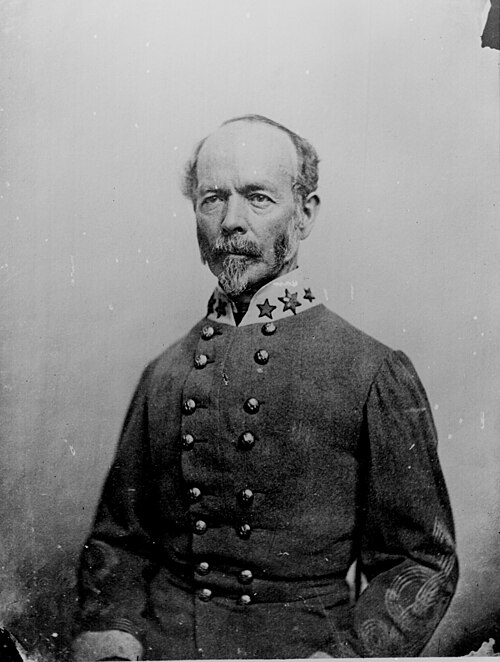
Another respected Confederate commander was Joseph E. Johnston. Johnston was one of the highest-ranking officers to resign from the United States Army and join the Confederacy. A cautious and highly professional commander, Johnston frequently clashed with Confederate President Jefferson Davis over military strategy. While critics accused him of retreating too often, Johnston understood that preserving his army was often more important than holding territory.
His defensive campaigns against Union General William T. Sherman during the Atlanta Campaign demonstrated considerable skill. Johnston repeatedly forced Sherman to maneuver around strong defensive positions rather than attack directly. Eventually, Davis replaced Johnston with the far more aggressive John Bell Hood, whose costly offensives led to the rapid loss of Atlanta and much of the Confederate Army of Tennessee. Many historians believe Johnston’s cautious approach, while frustrating politically, was militarily sound.
Together, these generals reveal the remarkable diversity of Confederate military leadership. Jackson embodied audacious offensive warfare. Longstreet demonstrated the power of disciplined defense. Stuart revolutionized cavalry reconnaissance. Forrest mastered highly mobile combat despite lacking formal training. Johnston emphasized patience and preservation of his forces over reckless attacks. Each left a distinct mark on Civil War history, and their campaigns continue to be studied by military historians today. While their abilities could not overcome the Confederacy’s overwhelming disadvantages in manpower, industry, and resources, their leadership ensured that the Civil War would become one of the most closely studied conflicts in military history.