
The story of the Trail of Tears is one of the most tragic chapters in American history. It was not simply the forced movement of the Cherokee people from their ancestral homeland. It was the collapse of a promise. For decades, many Cherokee leaders had attempted to prove that their nation could coexist peacefully alongside the expanding United States. They embraced many aspects of American society, built schools, farms, churches, and a constitutional government, yet in the end none of these efforts protected them. Their experience demonstrated that, for many white Americans in the early nineteenth century, cultural adaptation mattered less than the desire to acquire Cherokee land.
By the early 1800s, the Cherokee Nation occupied millions of acres across present-day Georgia, Tennessee, North Carolina, and Alabama. Rather than resisting every aspect of American influence, many Cherokee leaders pursued a strategy of accommodation. They adopted written laws, established courts, encouraged literacy, and developed a thriving agricultural economy. Some Cherokee families owned prosperous farms, raised livestock, and participated in regional commerce. Mission schools educated Cherokee children, and Christianity spread among portions of the population.
Perhaps the greatest symbol of this remarkable transformation was Sequoyah’s invention of the Cherokee syllabary. In an astonishing intellectual achievement, Sequoyah developed a written system for the Cherokee language that allowed thousands of Cherokee people to become literate within only a few years. The Cherokee Nation soon published one of North America’s first Native-language newspapers, the Cherokee Phoenix. In 1827, the Cherokee adopted a written constitution modeled in part after that of the United States, complete with executive, legislative, and judicial branches.
These developments reflected a sincere effort by many Cherokee leaders to demonstrate that their nation could flourish alongside the United States while maintaining its own identity. Leaders such as John Ross believed treaties, diplomacy, and the rule of law would secure their people’s future. The Cherokee had every reason to believe these efforts would be respected. The United States had repeatedly recognized the Cherokee Nation through treaties as a sovereign political community.
Yet events soon proved otherwise.
The greatest obstacle facing the Cherokee was not their culture but the increasing value of their land. The invention of the cotton gin in 1793 transformed the Deep South into the center of a booming cotton economy. Rich farmland became extraordinarily valuable, and the Cherokee homeland contained some of the most fertile land in the Southeast. When gold was discovered in northern Georgia in 1828, white settlers poured into Cherokee territory, demanding access to both farmland and mineral wealth.
Economic opportunity merged with longstanding racial prejudice. Many white Americans believed that American Indians, regardless of how much they adapted, remained obstacles to progress. Newspapers portrayed removal as both inevitable and even benevolent, claiming that moving west would preserve Native societies from extinction. Such arguments often disguised the far more obvious motivation: acquiring valuable land for white settlement and the expansion of slavery.
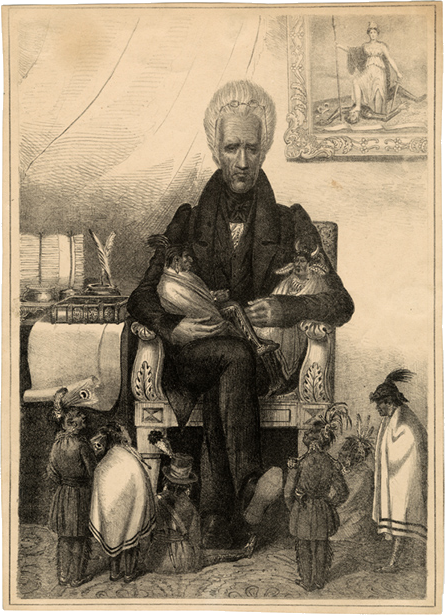
President Andrew Jackson became the most powerful advocate for removal. A veteran of wars against several American Indian nations, Jackson believed that the United States could not continue expanding while sovereign tribal nations remained within state boundaries. In 1830, Congress narrowly passed the Indian Removal Act, giving the federal government authority to negotiate the exchange of tribal lands east of the Mississippi River for territory in present-day Oklahoma.
The Cherokee did not simply surrender. They challenged Georgia’s attempts to dissolve their government and appealed to the United States Supreme Court. In the landmark case Worcester v. Georgia (1832), Chief Justice John Marshall ruled that Georgia had no authority over Cherokee territory because the Cherokee Nation possessed certain sovereign rights. Legally, it appeared to be a remarkable victory.
In practice, it changed almost nothing.
Jackson’s administration refused to enforce the Court’s ruling, and Georgia continued its efforts to seize Cherokee lands. A small faction of Cherokee leaders, acting without the approval of Principal Chief John Ross or the Cherokee National Council, signed the Treaty of New Echota in 1835. Though only a minority supported the agreement, the federal government treated it as legally binding. Most Cherokee citizens regarded it as illegitimate, but their protests failed.
In 1838, federal troops under General Winfield Scott began the forced removal.
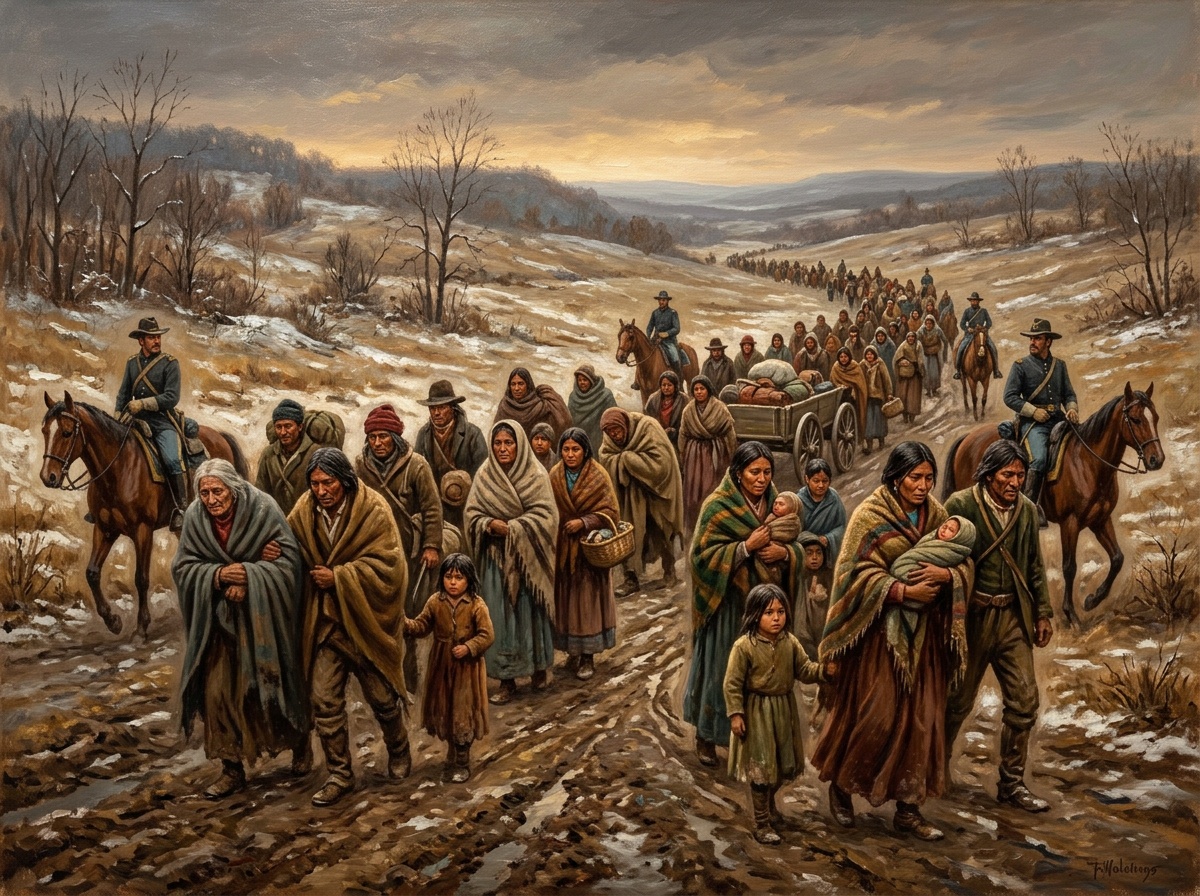
Soldiers entered Cherokee communities with little warning. Families were ordered from their homes, often carrying only what they could hold in their hands. Livestock, crops, homes, and personal possessions were abandoned or seized by others. Some families watched strangers move into houses they had built with their own labor while they were marched away at gunpoint.
The Cherokee were first confined in overcrowded stockades where disease spread rapidly. Then began the long journey of roughly 800 miles to Indian Territory. Thousands traveled on foot through rain, mud, snow, and freezing temperatures. Food was often scarce, clean water limited, and medical care almost nonexistent. Children suffered from exposure. Elderly people collapsed from exhaustion. Mothers buried infants beside the trail before continuing the march because there was no alternative.
Approximately 16,000 Cherokee were removed, and historians estimate that around 4,000 died from disease, starvation, exposure, or exhaustion during the removal and its immediate aftermath. Entire families disappeared. Ancient communities that had existed for generations vanished forever. Sacred places, burial grounds, and centuries of history were left behind.

For the Cherokee, the Trail of Tears became more than a journey. It became a defining national trauma passed from one generation to the next.
The tragedy also exposed a painful contradiction within the American republic. The United States celebrated constitutional government, property rights, and the rule of law, yet when valuable land stood in the way of expansion, those principles often yielded to political power, economic greed, and racial prejudice. The Cherokee had embraced many institutions admired by American society. They had negotiated treaties, established schools, written constitutions, published newspapers, and sought justice through American courts. None of it ultimately protected them.