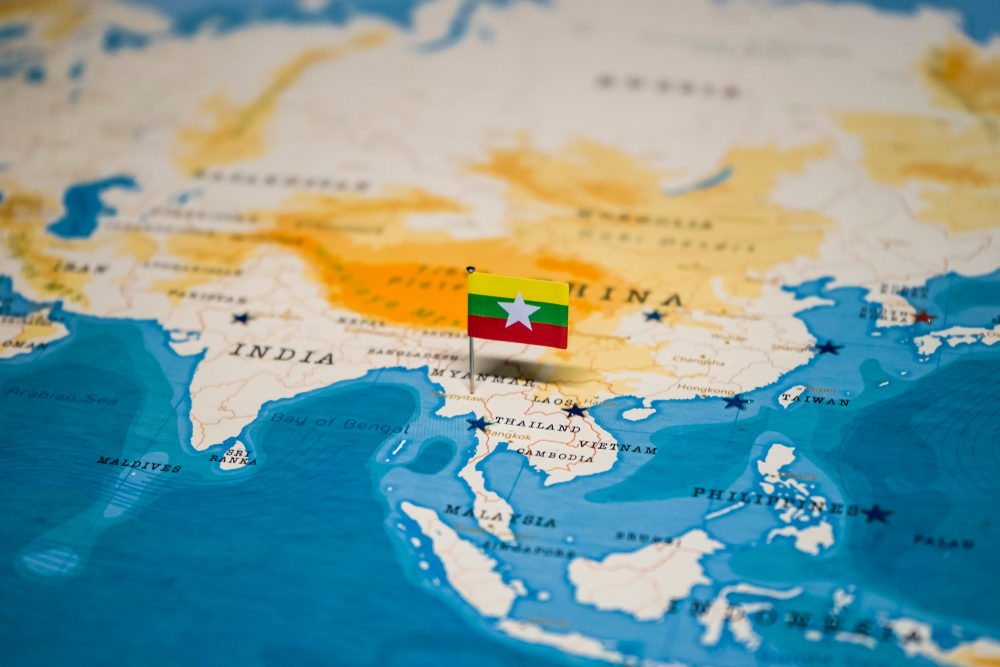
What happened: Myanmar’s military has deployed hundreds of troops—about 700 according to conflict monitor ACLED—into the southern Tanintharyi region, backed by air and naval attacks, to recapture territory surrounding the planned Dawei deep-sea port and special economic zone. Reuters reports that troops have burned homes and villages while forcing resistance groups to retreat. The offensive is explicitly linked to securing the strategic project, which Myanmar’s government is now attempting to revive with Russian support. (Reuters)
Human cost: Local resistance sources say three humanitarian workers were detained and killed, while ACLED reports that advancing forces have killed civilians and raided villages. Reuters could not independently verify every local account. The larger Myanmar civil war has already killed an estimated 100,000 people and displaced more than 3.5 million; the U.N. says nearly 4 million people are internally displaced and more than 16 million need humanitarian assistance. (Reuters)
Why it matters: Dawei is not simply another battlefield town. The proposed complex includes a deep-water port on the Andaman Sea and a power plant, giving cargo an alternative route to the heavily trafficked Strait of Malacca. Russian officials are evaluating investment, and Reuters reports that Moscow sees the project as potentially giving Russia a commercial and strategic port footprint in the Indian Ocean. (Reuters)
The offensive therefore joins two important stories: Myanmar’s military campaign to recover territory lost since the 2021 coup, and Russia’s expanding strategic relationship with Myanmar. Junta leader Min Aung Hlaing discussed Dawei directly with Vladimir Putin in Moscow this week. (Reuters)
What changed: Myanmar’s military has fought resistance forces throughout the country for years. The new development is the emergence of a large, reinforced military operation specifically aimed at clearing and securing land around a Russia-backed strategic port project. That gives this offensive significance beyond Myanmar’s internal civil war and potentially expands Russia’s geopolitical presence in Southeast Asia and the Indian Ocean. (Reuters)