

From the first arrival of enslaved Africans in Virginia in 1619 to the vast cotton plantations of the mid-nineteenth century, slavery in America underwent a profound transformation. It did not remain a static institution. Over more than two centuries, it evolved from a labor system that shared some characteristics with other forms of bondage found throughout the world into one of history’s most rigid, racialized, and economically intensive systems of human exploitation. Understanding this transformation is essential for understanding both American history and the causes of the Civil War.
Slavery itself was not invented by America, nor was it unique to Europeans. For thousands of years before the Enlightenment, slavery existed across nearly every major civilization. Ancient Egypt, Greece, Rome, Persia, China, the Islamic world, Africa, and the kingdoms of Europe all practiced some form of slavery. Prisoners captured in war were frequently enslaved. Criminals could lose their freedom. People overwhelmed by debt sometimes sold themselves or their children into bondage. In many societies, slavery was primarily based on circumstance, conquest, or social status rather than race.
This does not mean these systems were humane. Many were extraordinarily cruel. Yet they were generally more fluid than the system that later developed in the American South. Slaves in the Roman Empire, for example, sometimes earned or purchased their freedom. In parts of Africa and the Middle East, enslaved people could rise to positions of military or political authority. Enslavement was often viewed as a condition rather than an inherited racial identity.
When English colonists established permanent settlements in North America during the early seventeenth century, they initially relied heavily upon indentured servants. These workers, many of them poor Englishmen, Irishmen, Scots, or other Europeans, agreed to work for several years in exchange for passage to America, food, and eventually their freedom. Life as an indentured servant was harsh. Many died before completing their contracts. Nevertheless, their servitude was temporary, and they retained legal recognition as persons rather than permanent property.
The arrival of approximately twenty Africans at Jamestown in 1619 occurred during this transitional period. Historians continue to debate the precise legal status of these first Africans, but early colonial records reveal a labor system that was still evolving. Some Africans gained their freedom, owned land, married, and even acquired servants of their own. During the first half of the seventeenth century, the legal distinction between African laborers and European indentured servants was often inconsistent and varied from colony to colony.
Over time, however, powerful economic incentives encouraged colonial leaders to abandon temporary labor in favor of permanent hereditary slavery. Tobacco cultivation demanded an enormous workforce. Plantation owners discovered that purchasing enslaved Africans for life became more profitable than continually replacing indentured servants whose contracts eventually expired. At the same time, England’s expanding participation in the Atlantic slave trade made enslaved labor increasingly available.

Colonial legislatures gradually transformed these economic preferences into law. During the late seventeenth century, Virginia and other colonies passed laws declaring that slavery would be inherited through the mother, that Africans and their descendants could be held in perpetual bondage, and that baptism into Christianity no longer altered an enslaved person’s legal status. Marriage between races was prohibited, and legal protections available to white servants disappeared for Black laborers. Race increasingly became the defining feature of slavery.
This legal revolution fundamentally changed American society. Instead of slavery being one possible condition among many, it became closely identified with African ancestry. By the eighteenth century, the colonies had created a racial caste system in which skin color largely determined legal status at birth. Generations of children inherited slavery regardless of anything they had personally done. This marked a significant departure from many earlier systems of slavery found throughout world history.

The transformation accelerated dramatically after the invention of Eli Whitney’s cotton gin in 1793. Before that invention, cotton was difficult to process profitably because removing seeds from short-staple cotton required countless hours of labor. The cotton gin revolutionized production, making cotton immensely profitable across the Deep South. As British and New England textile mills demanded ever-increasing quantities of raw cotton, southern planters expanded westward into Alabama, Mississippi, Louisiana, Arkansas, and Texas.
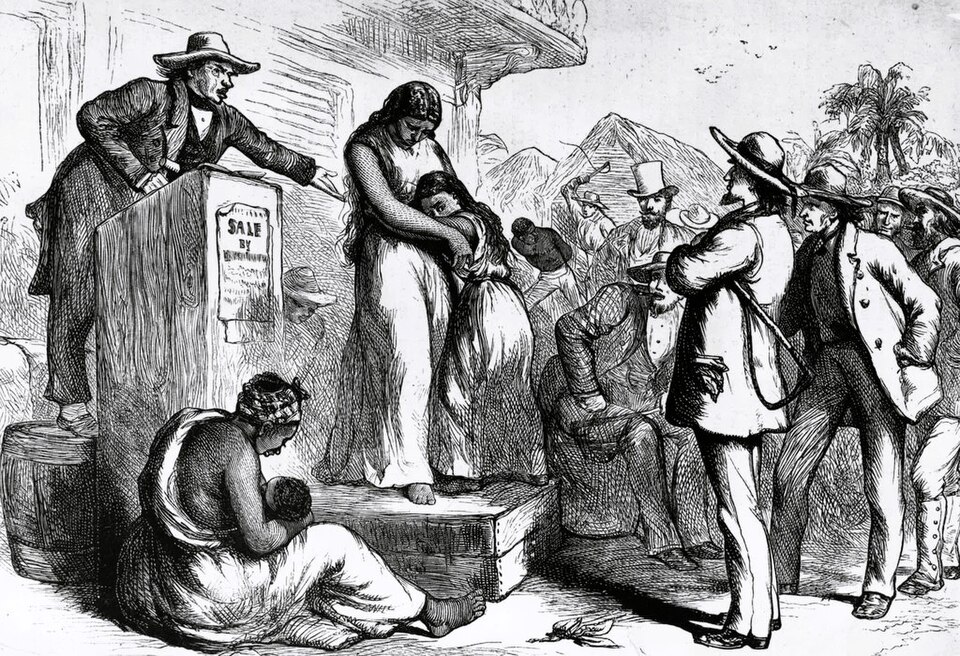
The phrase “King Cotton” captured this new economic reality. Cotton rapidly became America’s most valuable export and supplied much of the raw material fueling the Industrial Revolution in Britain and Europe. Fortunes were built upon cotton production, and with those fortunes came an exploding demand for enslaved labor. Although Congress outlawed the international slave trade in 1808, the domestic slave trade flourished. Hundreds of thousands of enslaved men, women, and children were forcibly separated from their families and sold from the Upper South into the expanding cotton frontier.
As cotton became king, slavery became even more brutal. Plantation owners sought maximum productivity from every acre and every worker. Labor was increasingly organized through systems of close supervision, gang labor, and relentless quotas. Enslaved people worked from before sunrise until after sunset during harvest seasons. Punishments for failing to meet production expectations often included whipping, shackling, or sale away from loved ones. The economic value of enslaved people also increased dramatically, causing them to be viewed even more explicitly as financial assets whose bodies generated wealth.
To justify this increasingly oppressive system, many defenders of slavery embraced racial theories that claimed Africans were naturally inferior. These ideas were not the original cause of slavery, but they became powerful justifications for preserving it. Racist pseudoscience, distorted biblical interpretations, and political arguments combined to defend an institution that had become central to the southern economy. By the middle of the nineteenth century, slavery was no longer merely tolerated by many southern leaders—it was increasingly defended as a “positive good” essential to civilization itself.
The story of American slavery is therefore one of transformation. It began within a world where slavery existed across many civilizations and where status often depended more upon conquest or class than race. Yet economic opportunity, legal innovation, and the extraordinary profitability of cotton reshaped slavery into a permanent, hereditary, race-based institution unlike anything the American colonies had initially known. By the eve of the Civil War, King Cotton had created an economic empire built upon millions of enslaved people whose labor enriched a nation while denying them even the most basic human freedoms.